GUIDED TRADING INTELLIGENCE
For traders who are tired of guessing which signal to trust—and aren’t ready to risk real money just to find out.
Make Trading Decisions You Can Understand Before You Risk Real Money
When a setup looks good, you should be able to see what supports it, what could stop it, and why—before money is on the line.
TradeProcess AI keeps the market read, strategy test, risk check, paper-trade result, and review in one place so you can follow the reasoning instead of rebuilding it later.
PAPER MODE · LIVE OFF · No live broker execution in the current customer environment.
PAPER MODE · LIVE OFFREAL CAPITAL OFFServer-owned authority

Illustrative product view · PAPER simulation
Evidence-DrivenRisk-First DesignPaper Trading DefaultNo Live Execution
01
THE PROBLEM
Another Indicator Turns Green. A Creator Says BUY. Your Chart Says Maybe. Your Risk Plan Says Nothing. So What Do You Trust?
Another signal appears. Another opinion sounds certain. Another strategy looks perfect—until it doesn’t.
Then you change the indicator. Change the timeframe. Change the rules. Eventually you are not testing a process anymore. You are reacting.
02
THE SLIPPERY SLIDE
When Confidence Changes The Plan, The Plan Stops Being A Process.
You add another indicator.
You change the rules.
You move the stop.
You skip the next valid setup.
You start leaning on someone else’s conviction because they sound more certain.
Eventually You Are No Longer Trading The Process You Built. You Are Trading Your Confidence.03
THE COST OF DISCONNECTED TOOLS
One Trade Idea Turns Into Five Tabs And A Lot Of Backtracking.
The signal is in one place. The backtest is somewhere else. Risk gets checked later. By the time you review the paper trade, you are trying to remember what you saw in the first place.
The problem is not the number of tools. It is having to piece the decision back together after the fact.
- Jump between charting, research, and backtesting tools.
- Reconstruct why the setup looked valid at the time.
- Manually reconcile portfolio and trade-level risk.
- Translate technical outputs into an actual decision.
- Wonder whether the strategy changed—or your behavior did.
Your Trading Process Should Not Change Every Time Your Confidence Does.
04
THE MISSING LAYER
The Hard Part Is Not Finding Another Signal. It Is Knowing When An Idea Has Earned Your Trust.
Most tools can show you a signal, a backtest, or a chart. The harder question is whether the market context, evidence, and risk still support the same idea when you look at them together.
TradeProcess AI keeps those checks in one path, and a strong setup can still stop at the risk check.
MARKETWhat changed before I chose a ticker?
EVIDENCEWhat supports or weakens the strategy?
SAFETYDo my limits allow this trade?
DECISIONWhat happens next?
05
INTRODUCING TRADEPROCESS AI
See The Whole Case Before You Decide What Comes Next.
The market read, strategy test, risk check, paper simulation, and review stay connected so you do not have to rebuild the story from separate tools.
The point is simple: see why the idea moved forward, where it was constrained, and what happened next.
UNDERSTANDStart with the broader market.
TESTSee whether the strategy holds up.
RISK CHECKSee whether the idea fits your risk limits.
SIMULATEPractice it with virtual capital.
REVIEWGo back through what happened and why.
06
THE TRANSFORMATION
Spend Less Time Rebuilding The Trade After It Happened.
Keep the reason, the risk check, and the paper result together so you can review the process instead of chasing the outcome.
The Signal Is Here. The Backtest Is There. The Risk Check Comes Later.
Every decision depends on remembering what changed across multiple tools, notes, tabs, and interpretations.
Understand The Market. Test The Setup. Check The Risk. Simulate. Review.
Follow the same path from the first market read through the paper-trade review, including the times a good-looking setup gets stopped by risk.
07
THE DECISION FILTER
Every Trade Idea Has To Prove Its Case Before It Moves Forward.
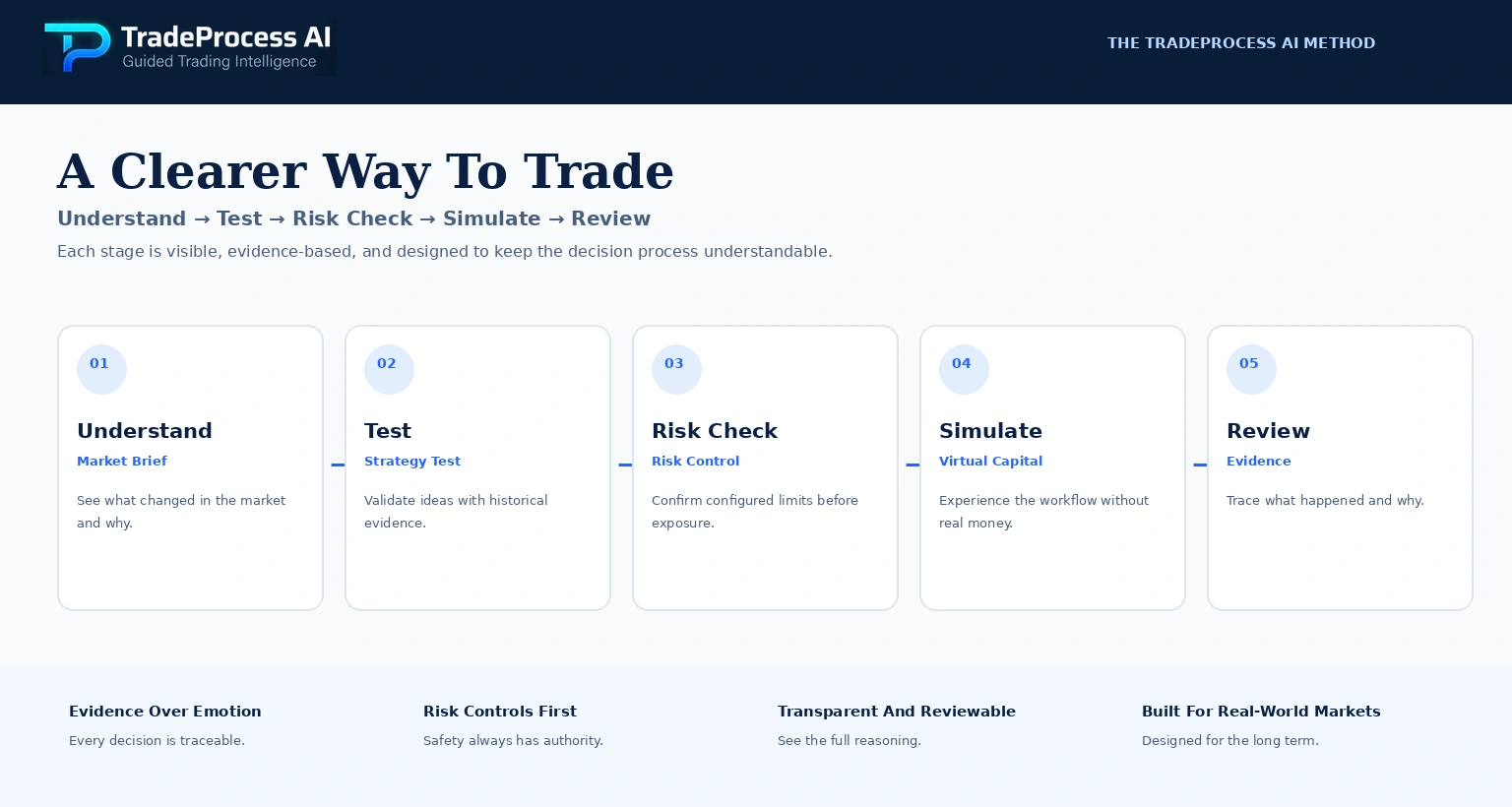
Start with the market. Test the setup. Check the risk. Simulate the trade. Then review what happened before you change the rules.
Understand
Start with the broader market before you lock onto one ticker.
Test
See how the strategy held up in the historical test.
Risk Check
See whether your risk limits allow the idea to move forward.
Simulate
Practice the trade with virtual capital while live execution stays off.
Review
Go back through what happened, why it happened, and what deserves review next.
08
ONE DECISION, END TO END
A Setup Can Look Good And Still Fail The Risk Check.
A setup can hold up in the strategy test and still run into a portfolio or risk limit. That check happens before a paper trade moves forward.
- 01Start with what the market is doing.
- 02Check whether the setup holds up.
- 03See Whether Your Risk Limits Allow It To Move Forward.
- 04The trade can still stop here.
- 05Then go back and see exactly why.
09
PRODUCT PROOF
Before You Trust A Trade Idea, See What It Is Actually Based On.
Each view helps answer a question you should be able to answer before moving forward: what changed in the market, what supports the setup, whether your risk limits allow it, and what happened next.
02 · MARKET BRIEF
Look At The Market Before You Fall In Love With One Ticker.
Check breadth, sectors, ETFs, and the day’s biggest movers before one chart takes over your attention.
- Broader market context
- Explicit source and timing cues
- Illustrative / simulated market data

03 · STRATEGY TEST
See How The Strategy Held Up Before You Put More Faith In It.
Review the historical results, drawdown, and test settings so you can see where the strategy held up—and where it didn’t.
- Historical evidence
- Visible test configuration
- Past performance is not a forecast

04 · RISK CHECK
A Good Setup Can Still Be Too Much Risk.
A strategy can still look solid when a portfolio or risk limit is reached. When that happens, the idea stops there.
- Risk Limit Reached
- No Additional Exposure
- Held By Risk Control

05 · SIMULATE
Practice The Trade Without Putting Real Money On The Line.
Use virtual capital to follow positions and outcomes in a paper-only environment, with no live broker execution.
- Virtual capital
- PAPER MODE · LIVE OFF
- No real-money order authority

10
EXPLORE THE PLATFORM
Go Deeper Without Losing The Thread.
Move from research to risk to review without losing why the trade looked valid, what stopped it, or what happened next.
PAPER TRADING
Practice The Trade With The Reason Still Attached.
Move from a reviewed idea into a PAPER trade without losing the strategy, risk check, portfolio impact, or order state that explains why the action happened.
Explore this area →DECISION INTELLIGENCEBuild The Case Before You Trust The Trade.
Bring market context, strategy tests, research, regime fit, prior decisions, and saved analysis together so a trade idea can be challenged before it reaches risk or PAPER execution.
Explore this area →DETERMINISTIC RISKA Good Setup Still Has To Fit The Risk.
See the limits, portfolio capacity, drawdown posture, and protective controls before additional simulated exposure can move forward. A convincing strategy still has to fit the account.
Explore this area →EVIDENCE & REVIEWKeep The Record Honest After The Outcome.
Preserve what the system knew, which safety state applied, what PAPER action followed, and how the outcome matured before hindsight has a chance to rewrite the story.
Explore this area →OPERATIONSKnow Whether The System Is Healthy Before You Trust The Output.
See scheduler, reconciliation, provider, runtime, and service-health evidence in one place so a quiet screen is never mistaken for a healthy system.
Explore this area →WORKSPACE & SECURITYConnected Does Not Mean Authorized To Trade.
Manage settings, broker connection state, preferences, and user access while keeping configuration separate from permission to place a trade.
Explore this area →GOVERNANCEKeep Product Access Separate From Trading Authority.
Make roles, tenant boundaries, entitlements, audit state, and safety rules explicit so a new feature, plan, or admin permission cannot quietly become permission to risk capital.
Explore this area →11
RISK IN PRACTICE
A Positive Signal Does Not Outrank A Risk Limit.
A strategy can pass its test and still hit a risk limit. When that happens, the evidence stays visible and the trade stops.
- 01Strategy passes the test
- 02Evidence stays visible
- 03Risk Limit Reached
- 04No Additional Exposure
THE REAL COST
Eventually The Problem Stops Feeling Like The Strategy. It Starts Feeling Like You.
A strategy looked convincing—until the first losing trade. Then came the extra indicator, the second opinion, the urge to change something. Eventually the real question surfaced: did the strategy fail, or did the process fall apart?
How Do You Know What To Trust?TradeProcess AI helps you examine the reasoning before capital is at risk—what the market is doing, what the evidence supports, and what would make you walk away.
12
WHAT YOU GAIN
Stop Rebuilding The Trade From Memory.
Keep the market read, strategy test, risk check, paper-trade result, and review together so the work you already did does not disappear the moment the outcome arrives.
- Start with broader market context instead of reacting to one isolated signal.
- Test the strategy rules and historical results before you put more confidence in the idea.
- See when a risk limit changes the answer, even when the setup still looks good.
- Practice with virtual capital while live broker execution stays off.
- Keep the decision, evidence, paper orders, and outcome together so you are not reconstructing them later.
- Reduce the manual work of jumping between research, backtesting, risk notes, and separate records.
- Use AI to organize and explain evidence without giving it risk or execution authority.
- Review what happened and why before you change the strategy or the rules.
13
EVIDENCE & REVIEW
The Decision Should Still Make Sense After The Moment Has Passed.
When you come back later, you should be able to see the market conditions, strategy, risk check, paper action, and source history that were there at the time—not the version your memory built afterward.
- Reconstruct why the decision existed.
- See which safety state shaped the result.
- Separate current data from stale context.
- Preserve source and audit context for later review.

14
AI AUTHORITY BOUNDARY
Know What The Product Does—And What It Never Controls.
AI can organize the evidence and explain what shaped a decision. It cannot change your risk limits, give itself trading authority, place orders, or override a safety block.
GOOD FIT
Use TradeProcess AI If You Want A Process You Can Inspect.
- You want to understand why a strategy result exists.
- You want market context before security-specific research.
- You want to test rules before trusting them.
- You want safety boundaries to remain visible and authoritative.
- You want to simulate with virtual capital before real-money execution.
NOT A FIT
If You Want Certainty, This Is The Wrong Promise.
- You want guaranteed returns or certainty about what the market will do next.
- You want an AI to place trades without deterministic controls.
- You want a black-box score you cannot inspect.
- You want historical results presented as future outcomes.
15
OBJECTIONS & QUESTIONS
Know What You Are Getting Before You Open The Workspace.
TradeProcess AI can make the evidence, risk checks, and paper-trading workflow easier to understand. It cannot remove market risk or make the next trade certain.
What makes TradeProcess AI different from a signal bot or stand-alone backtester?
It connects market context, strategy testing, deterministic risk, PAPER simulation, evidence review, and operational provenance in one inspectable process. AI can organize and explain evidence, but server-owned safety remains authoritative.
Do I have to understand complex strategy code?
No. The product is designed to surface plain-language decisions and supporting evidence before deeper technical detail.
Does TradeProcess AI place live trades?
No. The current customer environment is PAPER / simulation and live broker execution remains off.
Can I lose real money using the current product?
The current TradeProcess AI execution environment is PAPER-only and does not place live broker orders. Simulated performance still requires judgment and does not predict future market behavior.
Does a backtest predict future results?
No. Historical tests describe how configured rules behaved on historical inputs. They are evidence for review, not a forecast, promise, or guarantee.
What happens when risk reaches a configured limit?
A positive strategy candidate does not outrank deterministic risk. The result can become Risk Limit Reached, No Additional Exposure, or Held By Risk Control.
Can AI change my risk limits or place trades?
No. AI has no risk authority and no execution authority. Deterministic server-owned controls remain authoritative.
What happens when data is stale?
Previously loaded context can remain visible with stale-state disclosure, while relevant actions stay constrained until fresh server-owned state is available.
16
PRACTICE BEFORE CAPITAL
Practice The Process Without Putting Real Money On The Line.
The current customer environment is paper-only. You can review market context, strategy evidence, risk decisions, positions, and outcomes while live broker execution stays off.
PAPER MODE · LIVE OFFNO REAL-MONEY BROKER ORDER
No countdowns, no fabricated scarcity, no performance promises—just a paper-only environment for practicing the process.
THE NEXT STEP
Stop Asking Which Signal Sounds Most Certain. Build A Process You Can Explain.
Open the workspace, work through the market read, test the strategy, check the risk, and practice the trade with virtual capital. Then come back and see what happened.
PAPER trading only · No live broker connection · No real-money execution