PAPER TRADING

Practice The Trade Without Losing The Reason Behind It

Move from a reviewed idea to a PAPER order without losing the strategy, risk check, current exposure, or portfolio picture that shaped the decision. Every simulated action keeps the reason behind it visible.

PAPER MODE · LIVE OFFREAL CAPITAL OFFAI execution authority · NoneAI risk authority · None
TradeProcess AI illustrative PAPER trading workspace.
Simulated product view · Trading Workspace

WHY THIS MATTERS

The trading workspace comes after evidence and risk. It is where an allowed PAPER decision gets practiced, not where a signal becomes trading authority.

THE PROBLEM

A Trade Is Hard To Review When The Reason Is Scattered Across Five Places

Paper practice is much harder to learn from when the setup is reviewed in one place, the position lives somewhere else, and risk is checked after the fact. By the time you review the result, you are rebuilding the trade from memory.

WHAT CHANGES

Keep The Idea, Risk Check, And PAPER Result Together

Keep the setup, risk decision, virtual-capital position, simulated order, and portfolio context together so you can review the whole PAPER trade afterward.

THE GOAL

Practice the complete trading process with virtual capital while preserving the evidence, risk decision, order state, and portfolio context that explain how the simulated action came to exist.

THE INPUTS

Before A PAPER Trade Moves, See What Has To Be True

A simulated order should never appear out of nowhere. The setup, risk decision, portfolio state, and recorded simulator state all shape what can happen next.

INPUT / EVIDENCE

Reviewed strategy candidate

A candidate should arrive with identifiable strategy logic and supporting evidence rather than as an isolated buy/sell signal.

INPUT / EVIDENCE

Deterministic risk decision

The verified risk state determines whether simulated exposure may increase, must be reduced, or must remain blocked.

INPUT / EVIDENCE

PAPER portfolio state

Cash, equity, current exposure, positions, and existing PAPER activity provide the account context for the next simulated decision.

INPUT / EVIDENCE

Execution and reconciliation state

Recorded PAPER orders, positions, fills, and reconciliation evidence show what the simulator actually did instead of what the user merely intended.

WHAT YOU GAIN

Keep The Trade And The Reason Together

Keep the setup, risk decision, virtual-capital position, simulated order, and portfolio context together so you can review the whole PAPER trade afterward.

  • See simulated exposure beside the strategy context that produced it.
  • Review PAPER bots, positions, and orders without implying that a live broker order exists.
  • Keep portfolio impact visible before treating one attractive setup in isolation.
  • Repeat the decision process with virtual capital while real-capital execution remains disabled.

HOW IT WORKS

From Reviewed Idea To Simulated Position, Without Skipping Risk

Review the setup, respect the boundary, simulate only what is allowed, then compare what you intended with what the simulator actually recorded.

  1. 01
    Review the candidate

    Start with the strategy context and evidence that produced the candidate. The trading workspace is deliberately downstream of that reasoning.

  2. 02
    Respect the risk gate

    Server-owned risk evaluates the request against the current envelope, portfolio capacity, drawdown posture, and protective state before additional PAPER exposure can advance.

  3. 03
    Simulate the action

    Allowed actions become virtual-capital orders and positions. The workspace records PAPER state without implying that a live broker order was created.

  4. 04
    Reconcile and review

    Compare intended action, recorded order state, position state, and later outcome so process quality can be reviewed separately from whether the trade happened to win or lose.

FEATURES IN DEPTH

The Trading Workspace Should Answer More Than “Did The Order Go Through?”

Each view answers a different question—from your current exposure to whether the simulator recorded the action you expected.

TradeProcess AI illustrative PAPER trading workspace.

SUBFEATURE 01

Trading Workspace

See virtual-capital portfolio state, strategy context, simulated positions, and order state in one place. The goal is to answer three practical questions: what changed, what is exposed, and what can safely happen next.

WHAT IT DOES

Provide one operating view for the current PAPER decision instead of forcing the user to reconstruct strategy, risk, position, and order context from separate tools.

WHAT YOU SEE
  • Virtual-capital account and exposure context
  • Current simulated positions and order state
  • Strategy and safety context relevant to the active decision
WHY IT MATTERS

The user can answer what changed, what is currently exposed, and what remains safe to do next without losing the reasoning that preceded the simulated action.

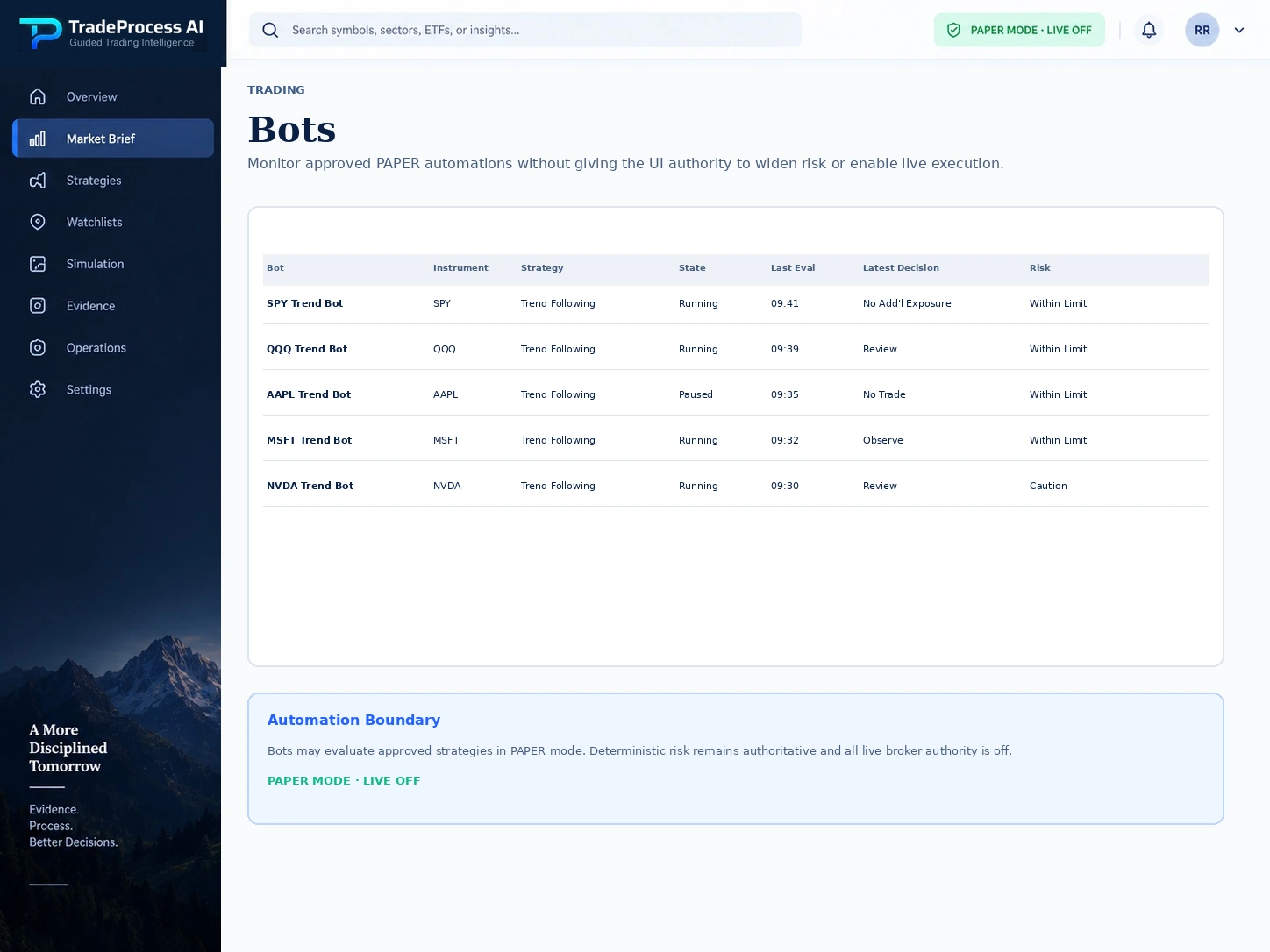
TradeProcess AI illustrative bounded PAPER bots screen.
PAPER MODE · LIVE OFF
PRODUCT VIEWBounded PAPER Bots

SUBFEATURE 02

Bounded PAPER Bots

Review a simulated bot’s instrument, timeframe, strategy, and operating state without giving it live execution authority. Start and stop controls still answer to verified server state and safety controls.

WHAT IT DOES

Represent automated PAPER strategy activity inside an explicit operating envelope rather than presenting automation as unlimited execution authority.

WHAT YOU SEE
  • Instrument and timeframe
  • Bot/circuit state
  • Strategy context and PAPER-only operating state
WHY IT MATTERS

Automation becomes inspectable practice. A running bot still remains subordinate to verified server state, risk controls, stale-data handling, and halt semantics.

Boundary: Starting or stopping a PAPER bot does not grant customer live execution authority.

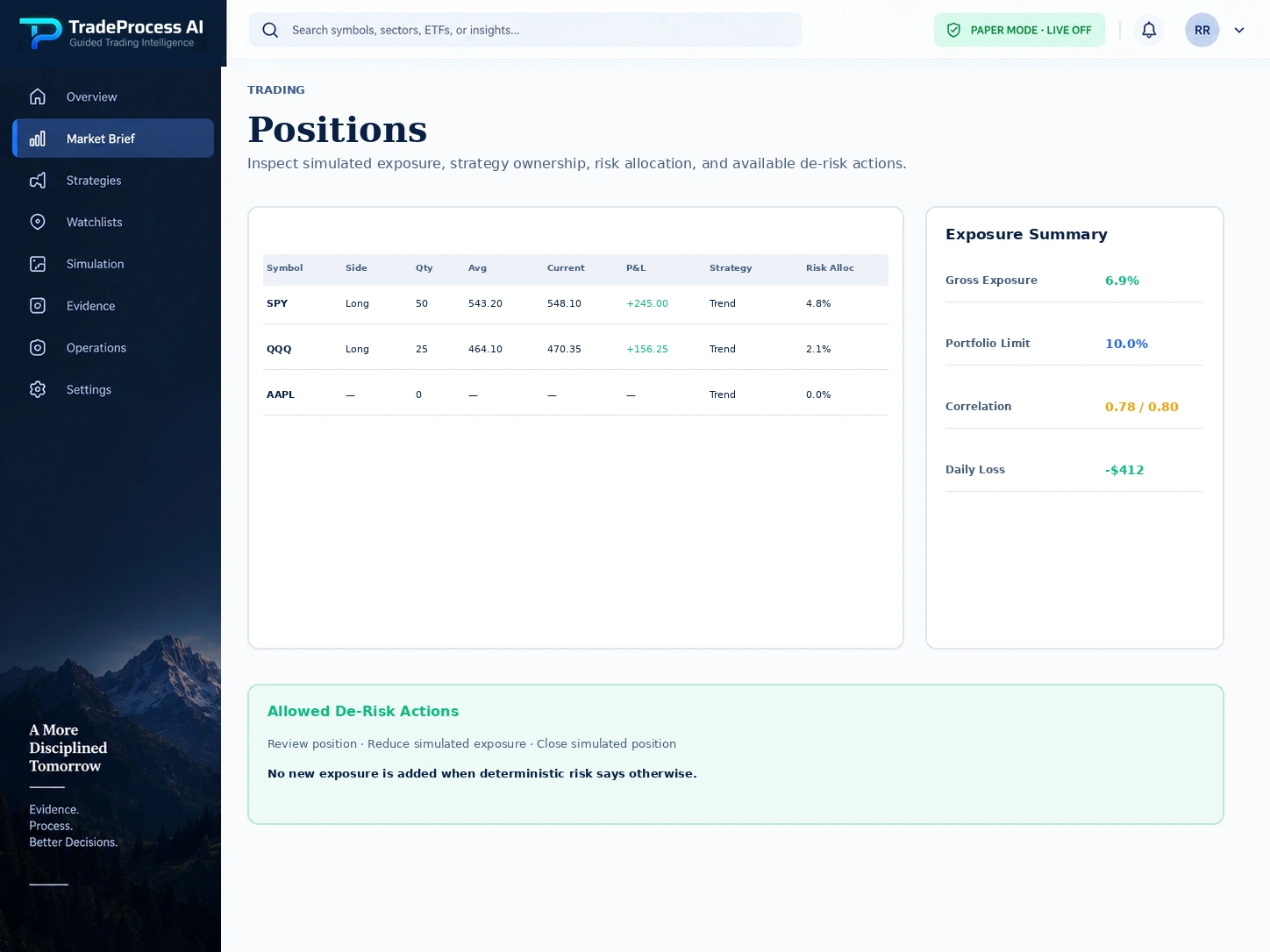
TradeProcess AI illustrative simulated positions screen.
PAPER MODE · LIVE OFF
PRODUCT VIEWSimulated Positions

SUBFEATURE 03

Simulated Positions

See virtual-capital positions, quantity, pricing, and exposure with the evidence and risk context still attached. Reduce or close actions remain PAPER actions and never create a real-money position.

WHAT IT DOES

Show the virtual-capital exposure that resulted from prior PAPER decisions and make reduce/close review possible without implying a real-money position exists.

WHAT YOU SEE
  • Instrument and quantity
  • Pricing and exposure context
  • Current PAPER position state
WHY IT MATTERS

A position is not just an outcome. It is part of the evidence trail for whether the original candidate, sizing, and risk process behaved as intended.

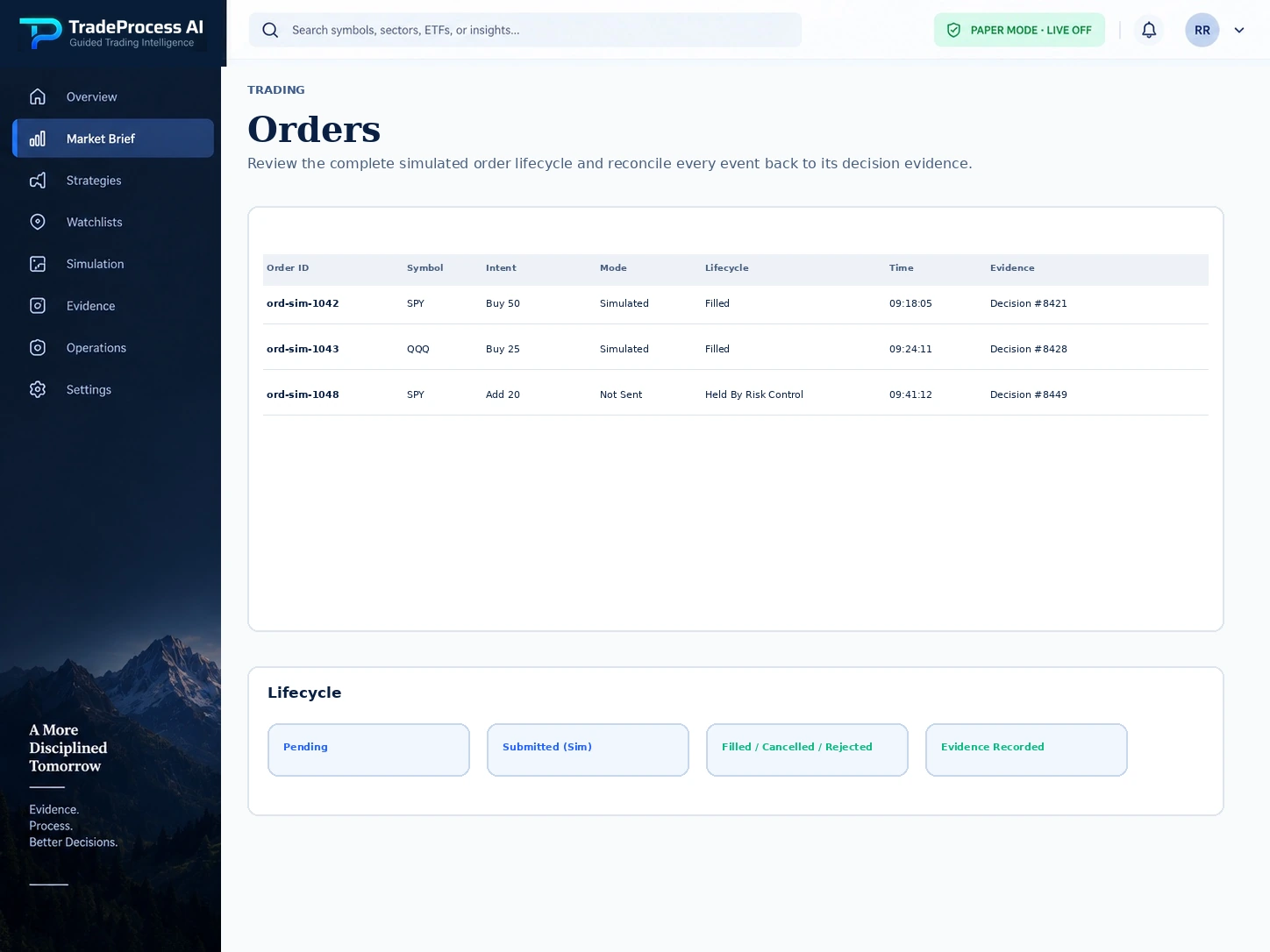
TradeProcess AI illustrative simulated orders screen.
PAPER MODE · LIVE OFF
PRODUCT VIEWSimulated Orders

SUBFEATURE 04

Simulated Orders

Compare the action you intended with the PAPER order the simulator actually recorded. The order state stays clearly separate from any real broker order.

WHAT IT DOES

Make intended PAPER actions and recorded order state auditable so users can tell whether a simulated decision was accepted, rejected, pending, or otherwise reconciled.

WHAT YOU SEE
  • Order identity and instrument
  • Recorded PAPER order status
  • Provenance connecting the order to the surrounding decision
WHY IT MATTERS

The difference between an idea and an executed simulation matters. Order state prevents the platform from treating intent as if it were already a position.

TradeProcess AI illustrative portfolio overview.

SUBFEATURE 05

Portfolio Overview

See cash, equity, exposure, positions, and current PAPER activity together so one attractive setup is never judged as if the rest of the portfolio does not exist.

WHAT IT DOES

Put each simulated trade inside the broader virtual-capital account instead of letting every setup be judged as if no other exposure exists.

WHAT YOU SEE
  • Cash and equity context
  • Current exposure and position state
  • Ongoing PAPER activity across the workspace
WHY IT MATTERS

Portfolio context is where concentration, capacity, and competing exposure become visible before the next decision is evaluated.

PRACTICAL USE CASES

When A Connected PAPER Workflow Matters Most

The connection matters when you repeat the process, carry overlapping exposure, or see a mismatch between what you intended and what the simulator recorded.

SCENARIO 01

Practice a strategy without live-capital pressure

A trader can follow the same candidate → risk → simulated order → position → review sequence repeatedly and inspect whether the process stays consistent across outcomes.

SCENARIO 02

Investigate a mismatch between intent and simulator state

If a candidate was expected to create PAPER exposure but no position appears, the decision trail and recorded order state make it possible to distinguish a risk block, halted path, or simulation-state issue from a missing click.

HOW IT CONNECTS

The Trade Is Where Research, Risk, And The Account Come Together.

A PAPER trade comes after the research and risk checks, and only when the current system status allows it. The surrounding workspaces show why the simulated action exists.

Decision Intelligence

Supplies the market, strategy, regime, and research context that explains why a candidate deserved review.

Deterministic Risk

Decides whether and how much additional simulated exposure is permitted. Positive intelligence cannot bypass it.

Evidence & Review

Preserves the decision, simulated action, provenance, and later outcome so the PAPER process can be reconstructed after the fact.

LIMITATIONS & BOUNDARIES

PAPER Trading Teaches Process, Not Future Results

Simulation is useful for process practice, but it does not reproduce every condition, fill, cost, or emotion of real-money execution.

  • PAPER activity is simulation. It does not create a customer live broker order or expose real capital.
  • Simulated fills, costs, and outcomes are review evidence; they are not guarantees of future execution quality or performance.
  • Missing, stale, or unreconciled runtime state may restrict the workflow rather than being treated as permission to continue.
  • AI can explain the trading context, but it cannot authorize execution or override deterministic risk.

SAFETY BOUNDARY

Simulation Lets You Practice Execution. Live Trading Stays Off.

AI execution authority
None
AI risk authority
None
Deterministic risk controls
Authoritative
Customer live broker execution
Off
Manual reduce / close during halt
Preserved

CAPABILITY QUESTIONS

Questions About Bots, Orders, Positions, And PAPER Trading

These answers cover PAPER bots, simulated orders, positions, portfolio context, and the line between practice and live execution.

Does starting a PAPER bot send live orders?

No. Customer live broker execution remains off. PAPER bot state is bounded simulation state and does not grant live submit, cancel, or replace authority.

What happens when risk blocks a candidate?

The workflow should preserve the reason and safe next action, but it does not increase simulated exposure simply because the strategy evidence is positive.

Why keep orders, positions, and portfolio state together?

Because a strategy idea can look acceptable in isolation while the account already carries conflicting or excessive exposure. The connected view makes the simulated decision reviewable at portfolio level.

Does this capability change the PAPER / live-off boundary?

No. Customer execution remains PAPER / simulation and live broker execution is off. AI remains advisory and deterministic server-owned safety controls remain authoritative.

GUIDED TRADING INTELLIGENCE

Practice The Process Until You Can See Where It Breaks

Use virtual capital to repeat the full decision sequence, spot where it changes, and review the result before real money is ever involved.

Create your workspaceExplore other features
PAPER MODE · LIVE OFF · Customer live broker execution is off.