Convenience Becomes Risk When Permission And Authority Blur Together
As the platform grows, convenience can blur who is allowed to do what. A plan change, role change, or admin action should never be mistaken for permission to trade live capital.
GOVERNANCE
Keep user roles, workspace boundaries, feature access, audit records, and safety rules clear so adding product capability never changes trading authority.
WHY THIS MATTERS
As the platform grows, convenience can blur who is allowed to do what. A plan change, role change, or admin action should never be mistaken for permission to trade live capital.
Keep roles, entitlements, audit history, and authority boundaries explicit so the product can grow without turning AI, billing, or admin convenience into trading permission.
Keep automation level, entitlement, tenant/role authority, audit history, and safety policy explicit so product growth cannot turn AI capability, billing, or administrative convenience into permission to risk capital.
THE INPUTS
Know which workspace a user belongs to, what their role allows, which features they can access, which safety functions remain available regardless of plan, and which administrative actions were recorded—without changing who controls trading authority.
Requested and effective automation levels define how much bounded autonomy the product may exercise inside deterministic limits.
Workspace/tenant identity and privileged roles determine who may perform administrative actions and which customer resources they can affect.
Commercial capability metadata can control product breadth, capacity, or advanced features without becoming a path around safety-critical controls.
Consequential changes need durable records so operators can reconstruct who changed what, when, and under which authority.
WHAT YOU GAIN
Keep roles, entitlements, audit history, and authority boundaries explicit so the product can grow without turning AI, billing, or admin convenience into trading permission.
HOW IT WORKS
Identify who is making the change, confirm which features they can access, keep safety functions available regardless of plan, and record the administrative action in the audit trail.
Start with the customer or operator request: automation level, product capability, administrative change, or entitlement.
Server-owned policy can reduce the requested automation/configuration when risk, safety, entitlement, or authority boundaries require a more restrictive state.
Risk, reconciliation, halt, stale-data, duplicate-order prevention, emergency reduce/close, essential audit, and account-security functions remain available regardless of commercial quota.
Privileged actions and material policy changes remain traceable so governance decisions can be reviewed independently of the market outcome.
FEATURES IN DEPTH
Feature access, user roles, workspace separation, audit records, and safety rules each protect a different part of how the platform is controlled.
SUBFEATURE 01
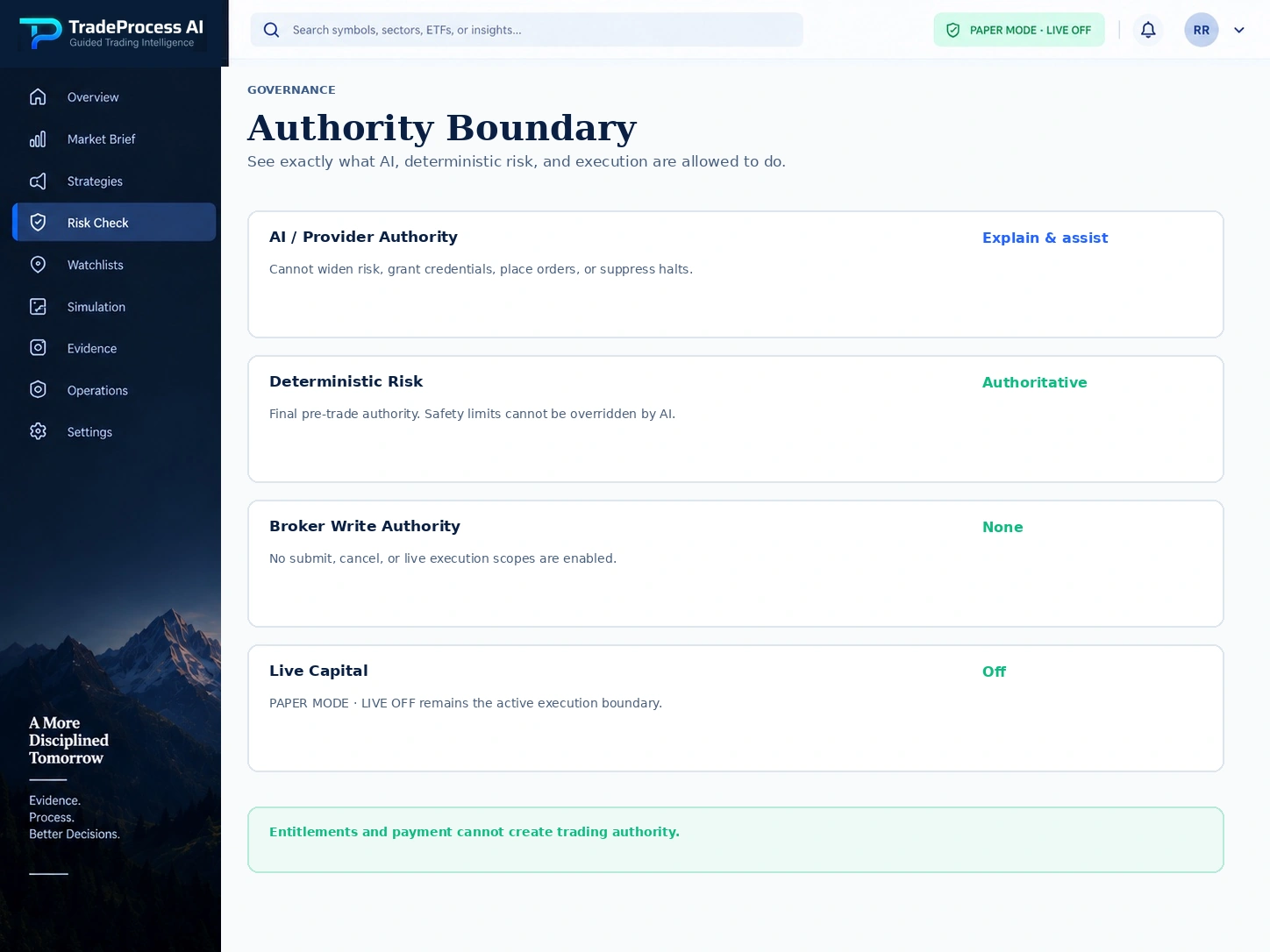
See which parts of the system can explain, constrain, configure, or act—and which cannot. Advisory intelligence remains subordinate to server-owned authorization and risk.
Make the hierarchy between advisory AI, deterministic controls, administrative capability, and live-execution authority explicit.
Clear authority semantics reduce the chance that an explanation, entitlement, or admin action is mistaken for permission to risk capital.
SUBFEATURE 02
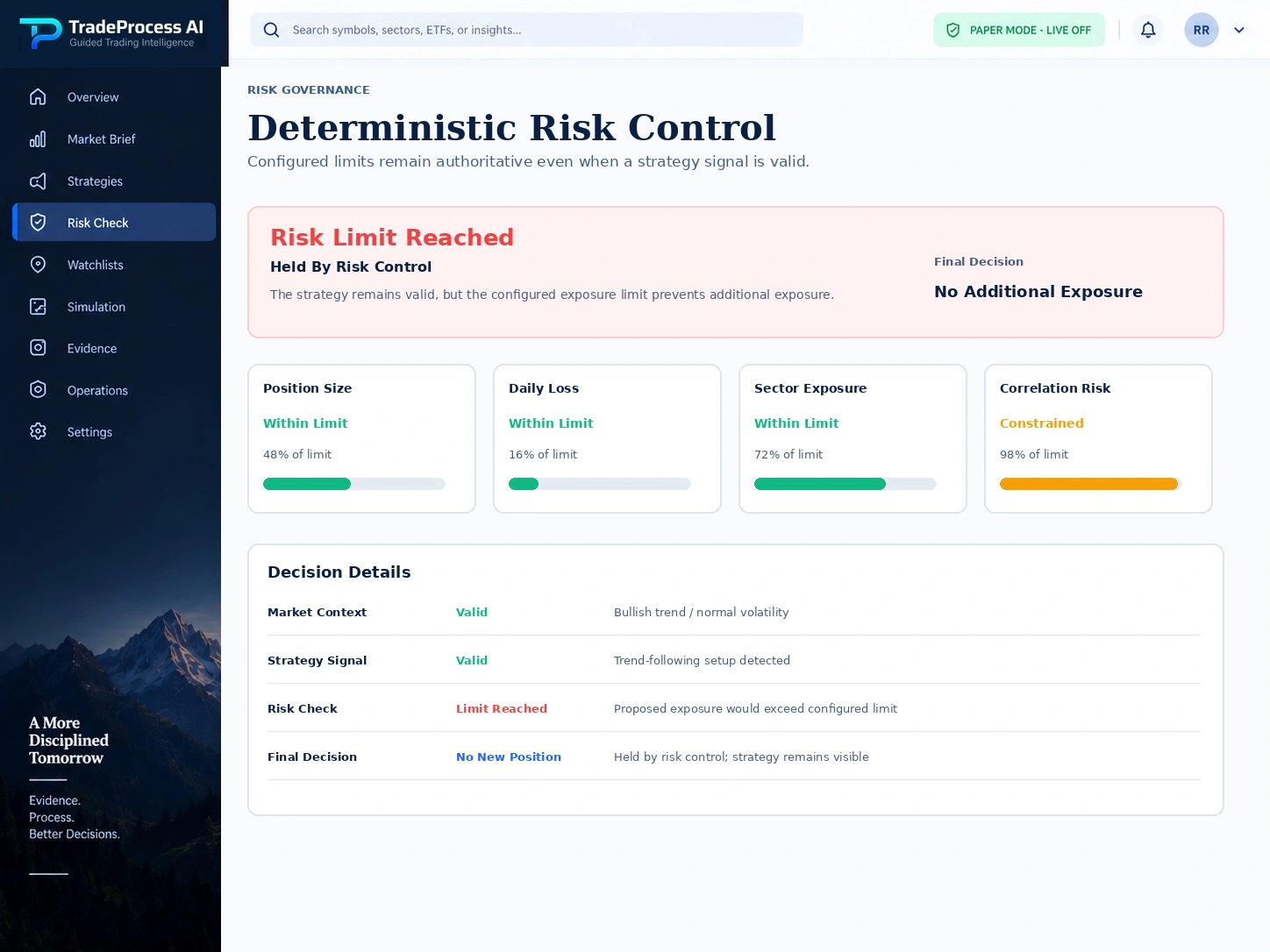
Keep risk control server-owned and authoritative regardless of AI confidence or commercial tier. The separation stays visible instead of hiding behind policy text.
Keep safety-critical risk control authoritative regardless of automation level or commercial tier.
The safety boundary should behave consistently even as product features, plans, or automation levels evolve.
SUBFEATURE 03
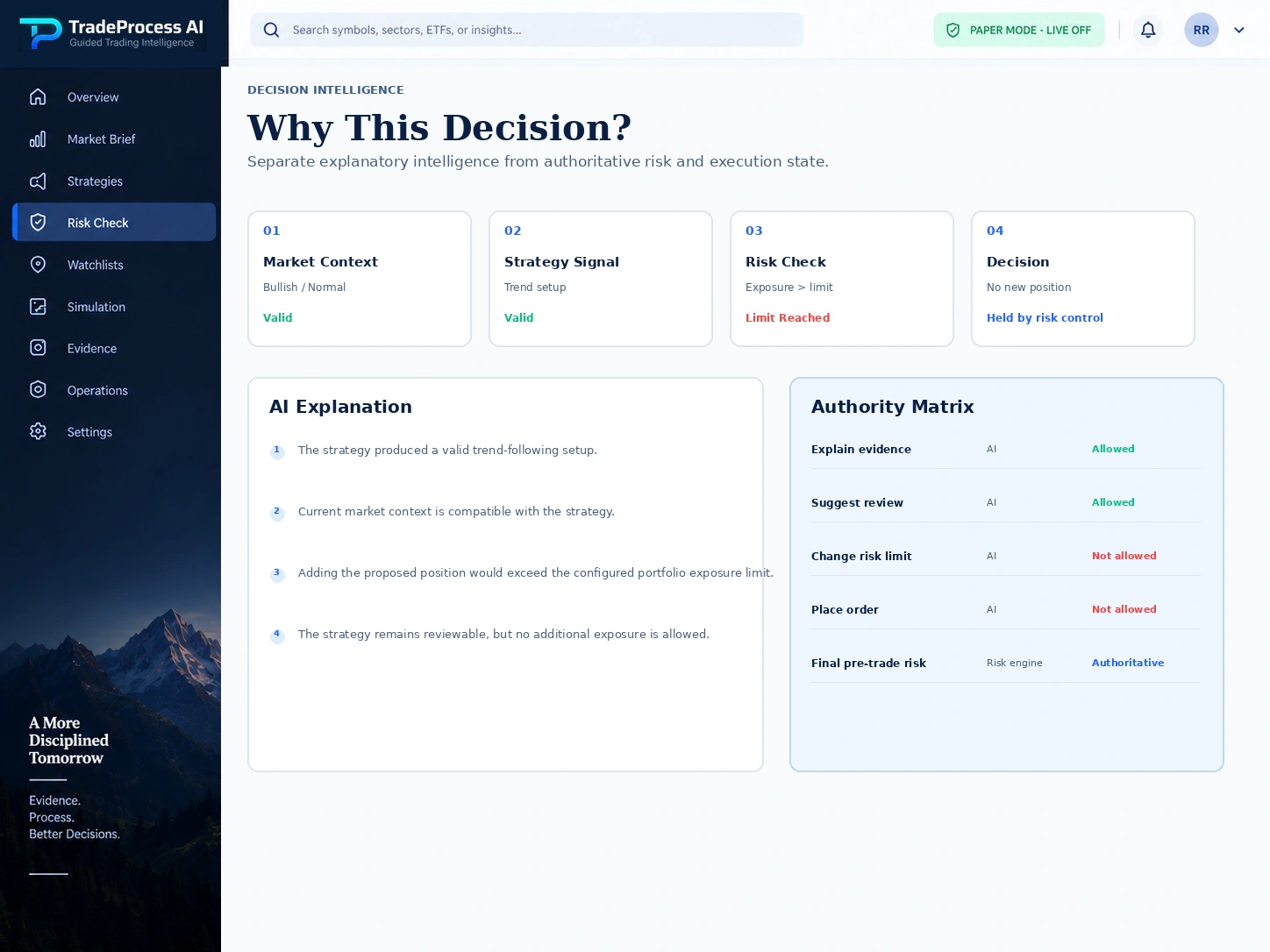
Keep explanation separate from authority so understandable reasoning never becomes permission to trade. AI can help interpret the evidence while deterministic controls remain final.
Allow the system to explain governance and decision state without converting explanation into authority.
Interpretability is useful only if the explanation cannot rewrite the authoritative control that it describes.
SUBFEATURE 04
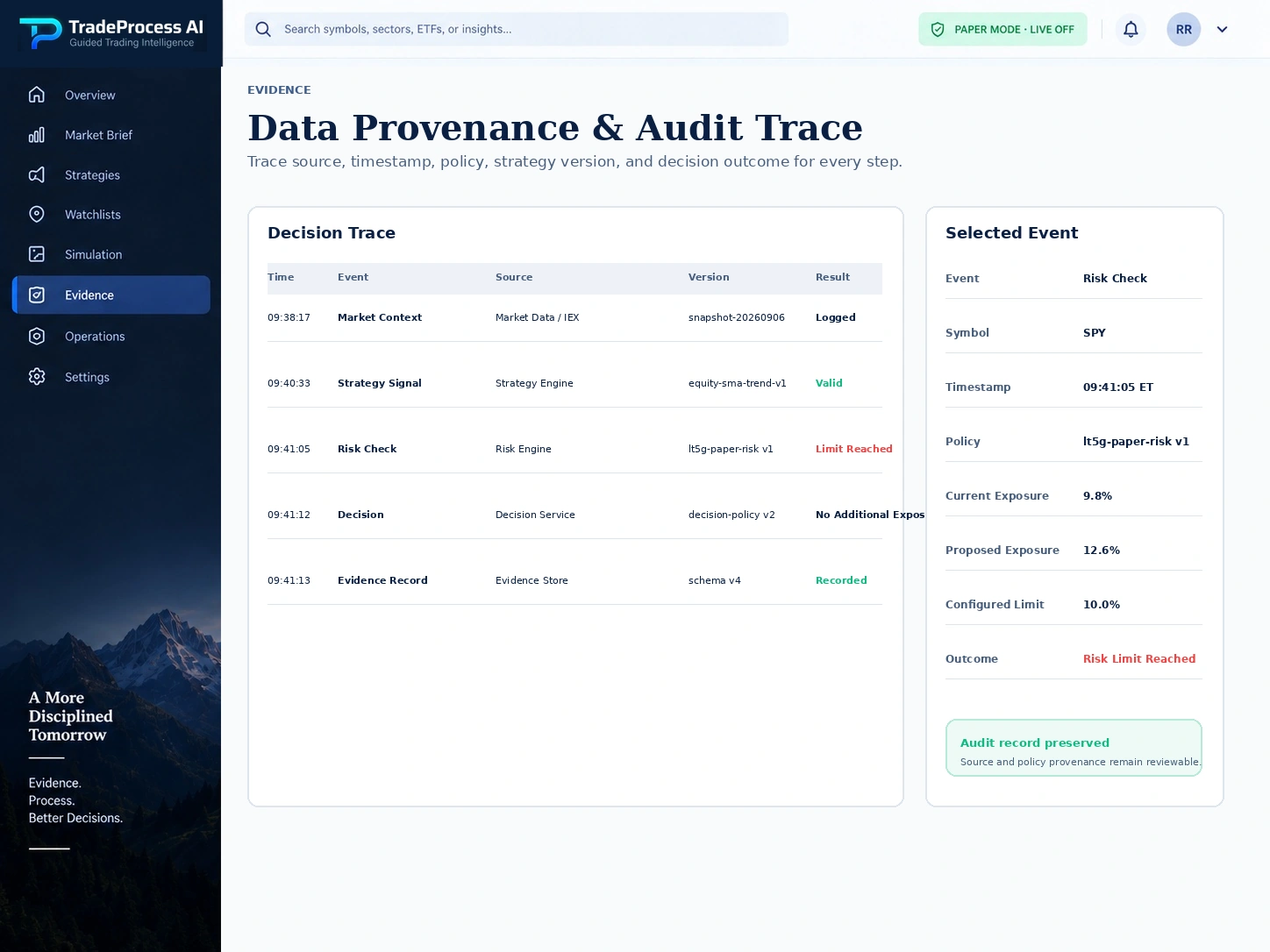
Preserve the source and timing behind consequential decisions so operators can distinguish verified state from inference or later interpretation.
Preserve traceable source and timing information for evidence, policy, and administrative decisions.
Governance depends on being able to reconstruct which state was authoritative when a consequential action occurred.
PRACTICAL USE CASES
Governance matters when a new plan unlocks features, a team role changes, or an administrative control could otherwise be confused with trading permission.
The entitlement can expand data breadth or advanced research capacity, but it cannot disable risk checks or automatically create live-trading authority.
The action should be authorized against the correct tenant/role boundary and persisted in the audit trail rather than treated as an untracked convenience operation.
DEEPER PLATFORM COVERAGE
Administrative views show which features a plan includes, what each user can access, and the audit record behind those changes.
HOW IT CONNECTS
Workspace access, product entitlements, risk controls, operations, and evidence all depend on governance rules that remain separate from market or strategy logic.
Applies tenant, role, account-security, and configuration boundaries to the customer workspace.
Protects the rule that safety-critical risk controls remain authoritative and cannot be commercially gated away.
Uses audit and runtime evidence to make consequential platform changes reconstructable and to keep readiness separate from authority.
LIMITATIONS & BOUNDARIES
Governance can control access and preserve safety rules, but it cannot turn an entitled feature into live-capital authority or guarantee a market outcome.
CAPABILITY QUESTIONS
These answers explain how feature access, workspace boundaries, audit records, and safety functions fit together without granting live-trading permission.
No. Entitlements can control product capability, breadth, or capacity, but live-capital authority remains a separate safety/governance checkpoint.
It describes the permitted degree of bounded autonomy. The effective level can still be reduced by risk, safety, entitlement, or authorization policy.
Safety-critical functions such as risk, reconciliation, halt, stale-data handling, duplicate-order prevention, emergency reduce/close, essential audit, and account security must remain available regardless of commercial quota.
No. Customer execution remains PAPER / simulation and live broker execution is off. AI remains advisory and deterministic server-owned safety controls remain authoritative.
GUIDED TRADING INTELLIGENCE
Let plans, roles, and features grow while safety functions, auditability, and trading authority remain explicit and separately governed.
PAPER MODE · LIVE OFF · Customer live broker execution is off.