DECISION INTELLIGENCE

Turn Market Noise Into Evidence You Can Challenge

Start wide, narrow carefully, and keep the research trail visible. Market context, strategy tests, regime fit, expected value, and saved analysis should build a case—not manufacture certainty.

PAPER MODE · LIVE OFFREAL CAPITAL OFFAI execution authority · NoneAI risk authority · None
TradeProcess AI illustrative Market Brief.
Simulated product view · Market Brief

WHY THIS MATTERS

AI can organize and explain the case. Strategy rules, deterministic risk, and trading authority remain separate.

THE PROBLEM

More Research Can Still Leave You Guessing

More indicators and more commentary can make an idea feel convincing without making the reasoning any better. When the market read, strategy logic, historical results, and prior decisions are scattered, it is easy to remember the conclusion and forget how you got there.

WHAT CHANGES

Build A Case You Can Challenge Before It Reaches The Risk Check.

Keep the market read, strategy evidence, research sources, and decision explanation in one trail so you can challenge the case before it moves downstream.

THE GOAL

Turn market context, configured strategy logic, regime state, expected-value evidence, research, and prior decisions into an inspectable reasoning trail before a candidate reaches risk or PAPER execution.

THE INPUTS

See What The Research Is Actually Built On

Good analysis starts with visible inputs: market regime, configured rules, evidence quality, expected value, costs, freshness, and source context.

INPUT / EVIDENCE

Market context and regime state

Trend, volatility, liquidity, event, correlation, breadth, and freshness context can frame the environment in which a strategy is being considered.

INPUT / EVIDENCE

Configured strategy rules

A strategy definition and its parameters make the hypothesis explicit enough to test rather than relying on a narrative reconstructed after the outcome.

INPUT / EVIDENCE

Expected-value evidence

Win/loss behavior, estimated costs, regime fit, evidence quality, calibration quality, and staleness can contribute to whether an evidence set deserves trust.

INPUT / EVIDENCE

Research and provenance

Sources, timestamps, saved analysis, and prior decision records provide context for what was known at the time.

WHAT YOU GAIN

Keep The Research Attached To The Decision

Keep the market read, strategy evidence, research sources, and decision explanation in one trail so you can challenge the case before it moves downstream.

  • Start with the broader market before you lock onto one symbol.
  • Test the strategy rules against historical evidence instead of treating a score as proof.
  • Keep research sources and saved analysis attached to the decision they informed.
  • Use AI to organize and explain the evidence while strategy and risk rules stay separate.

HOW IT WORKS

From Market Context To A Candidate You Can Defend

Frame the market first, test the rule, judge the quality of the evidence, then record the reasoning before the idea moves to the risk check.

  1. 01
    Frame the market

    Begin with broader market and regime context before narrowing attention to a single ticker or strategy candidate.

  2. 02
    Test the strategy

    Apply configured rules to historical or saved evidence so the strategy hypothesis can be inspected independently of the current trade idea.

  3. 03
    Assess fit and evidence quality

    Expected value, regime fit, evidence quality, calibration quality, costs, and staleness help distinguish a promising result from one that is too weak or poorly supported.

  4. 04
    Record the reasoning

    Save the research and decision context that informed the candidate so later review can compare what was known then with what happened afterward.

FEATURES IN DEPTH

Give Each Research Tool One Clear Job

A market brief, strategy test, regime view, research record, and saved analysis each expose a different part of the reasoning.

TradeProcess AI illustrative Market Brief.

SUBFEATURE 01

Market Brief

Start with the broader market before you narrow attention to one ticker. The brief shows what changed and what deserves a closer look; it does not issue a trade command.

WHAT IT DOES

Create a broad context layer before the user narrows attention to one symbol or one strategy.

WHAT YOU SEE
  • Market-level context and notable changes
  • Signals that deserve investigation
  • Freshness/context cues rather than a trade command
WHY IT MATTERS

Starting with context helps reduce the tendency to make a single ticker explain the whole market environment.

TradeProcess AI illustrative strategy test.

SUBFEATURE 02

Strategy Test

Review configured rules, historical results, drawdown, and test settings as evidence you can question. A backtest is review material, not a forecast or guarantee.

WHAT IT DOES

Turn a strategy hypothesis into reproducible configured rules that can be compared against historical evidence.

WHAT YOU SEE
  • Strategy parameters and test context
  • Historical evidence and outcome summaries
  • Evidence that supports or weakens the configured hypothesis
WHY IT MATTERS

A reproducible test is easier to challenge than a discretionary story created after seeing the chart.

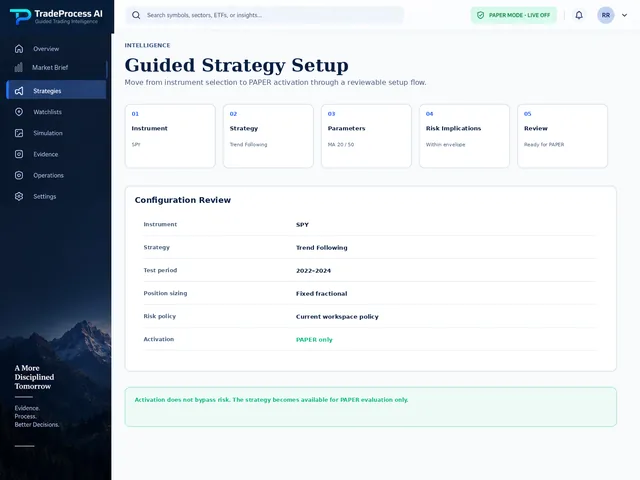
TradeProcess AI illustrative guided strategy setup screen.
PAPER MODE · LIVE OFF
PRODUCT VIEWGuided Strategy Setup

SUBFEATURE 03

Guided Strategy Setup

Set the instrument, strategy, parameters, and PAPER-only activation context explicitly before the idea enters the workflow. Configuration stays separate from risk authority.

WHAT IT DOES

Make instrument, strategy, parameters, and PAPER-only activation context explicit before a strategy becomes part of the workflow.

WHAT YOU SEE
  • Instrument and strategy selection
  • Configurable parameters
  • PAPER-only activation context and safety state
WHY IT MATTERS

Explicit setup reduces ambiguity about what logic was actually configured and keeps configuration separate from risk authority.

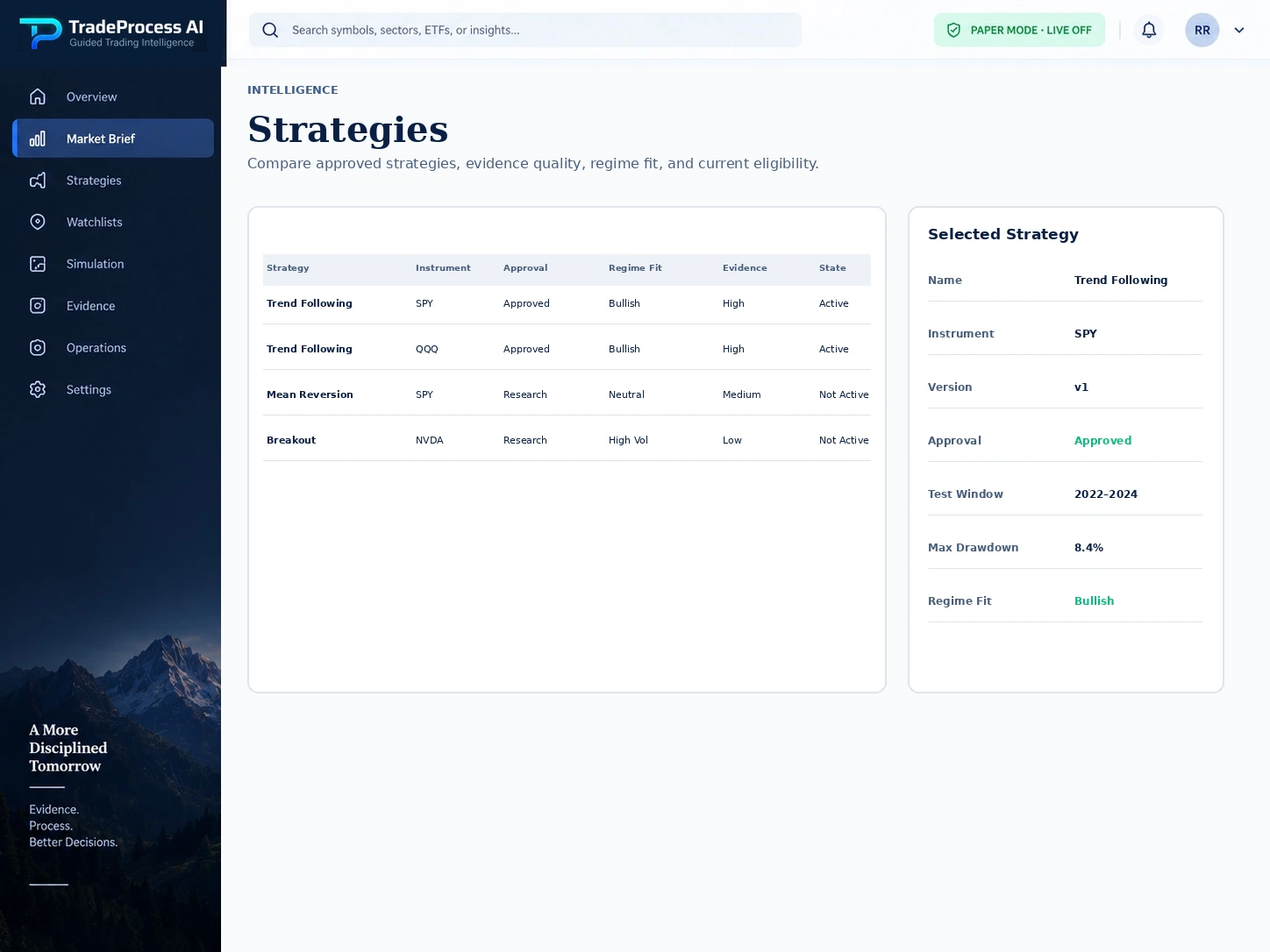
TradeProcess AI illustrative strategies screen.
PAPER MODE · LIVE OFF
PRODUCT VIEWStrategy Evidence

SUBFEATURE 04

Strategy Evidence

See the rules and evidence behind the current strategy state instead of receiving a confidence score with no explanation. Review what matched, what did not, and what could weaken the case.

WHAT IT DOES

Expose the evidence supporting the current strategy state instead of reducing the decision to a single score.

WHAT YOU SEE
  • Configured strategy logic
  • Supporting and missing evidence
  • The conditions that contributed to the current candidate
WHY IT MATTERS

The trader can inspect why the strategy qualified and which assumptions could invalidate that conclusion.

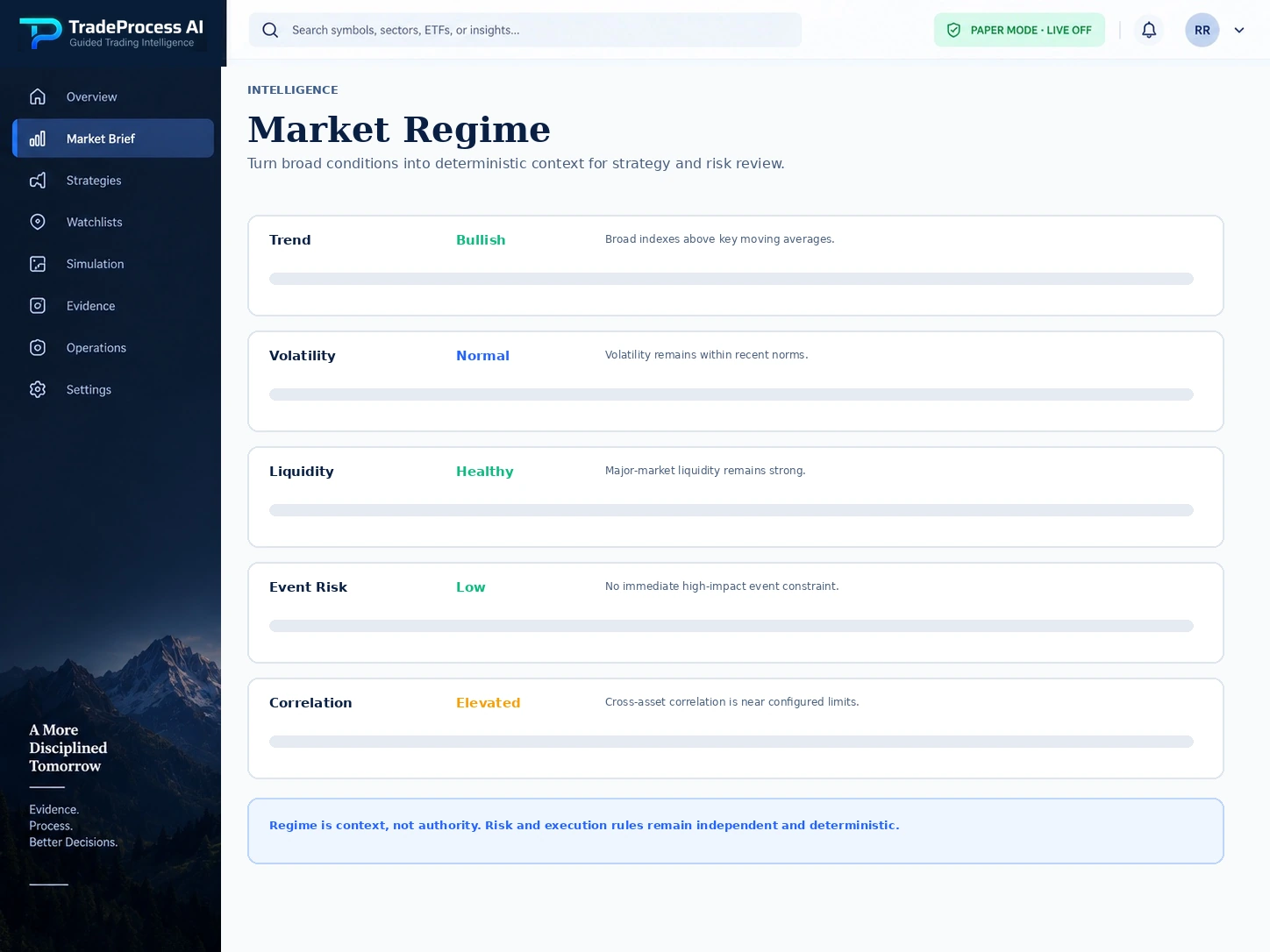
TradeProcess AI illustrative market regime screen.
PAPER MODE · LIVE OFF
PRODUCT VIEWMarket Regime Context

SUBFEATURE 05

Market Regime Context

Put the idea inside the current trend, volatility, liquidity, event, and correlation environment. Regime context can change how you read the evidence, but it does not predict direction or override risk.

WHAT IT DOES

Describe the current environment in dimensions relevant to strategy fit without pretending regime classification predicts direction.

WHAT YOU SEE
  • Trend/volatility/liquidity context
  • Event and correlation context when available
  • Freshness or unavailable-state indicators
WHY IT MATTERS

Strategies often behave differently across regimes. Making the regime explicit helps separate strategy quality from environment mismatch.

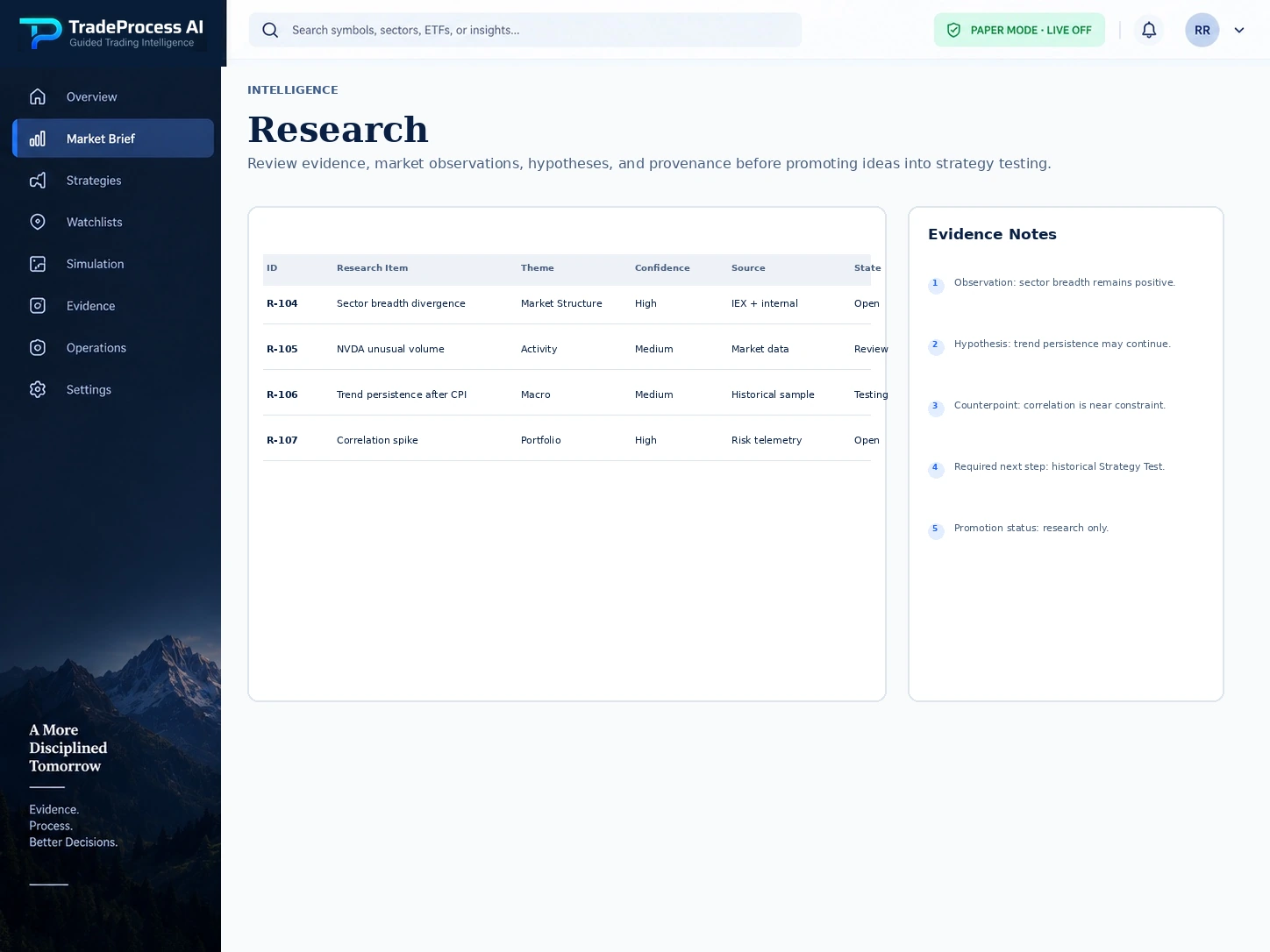
TradeProcess AI illustrative research screen.
PAPER MODE · LIVE OFF
PRODUCT VIEWResearch With Context

SUBFEATURE 06

Research With Context

Keep sources, timing, and the reason a piece of research mattered attached to the decision. That makes it easier to separate what you knew then from the story you tell after the outcome.

WHAT IT DOES

Keep research material attached to source, time, and decision context rather than becoming an untraceable collection of notes.

WHAT YOU SEE
  • Research source and timing
  • Saved analysis linked to the decision
  • Context for why the source mattered when it was reviewed
WHY IT MATTERS

Provenance makes it easier to distinguish what was known before the decision from explanations created after the outcome.

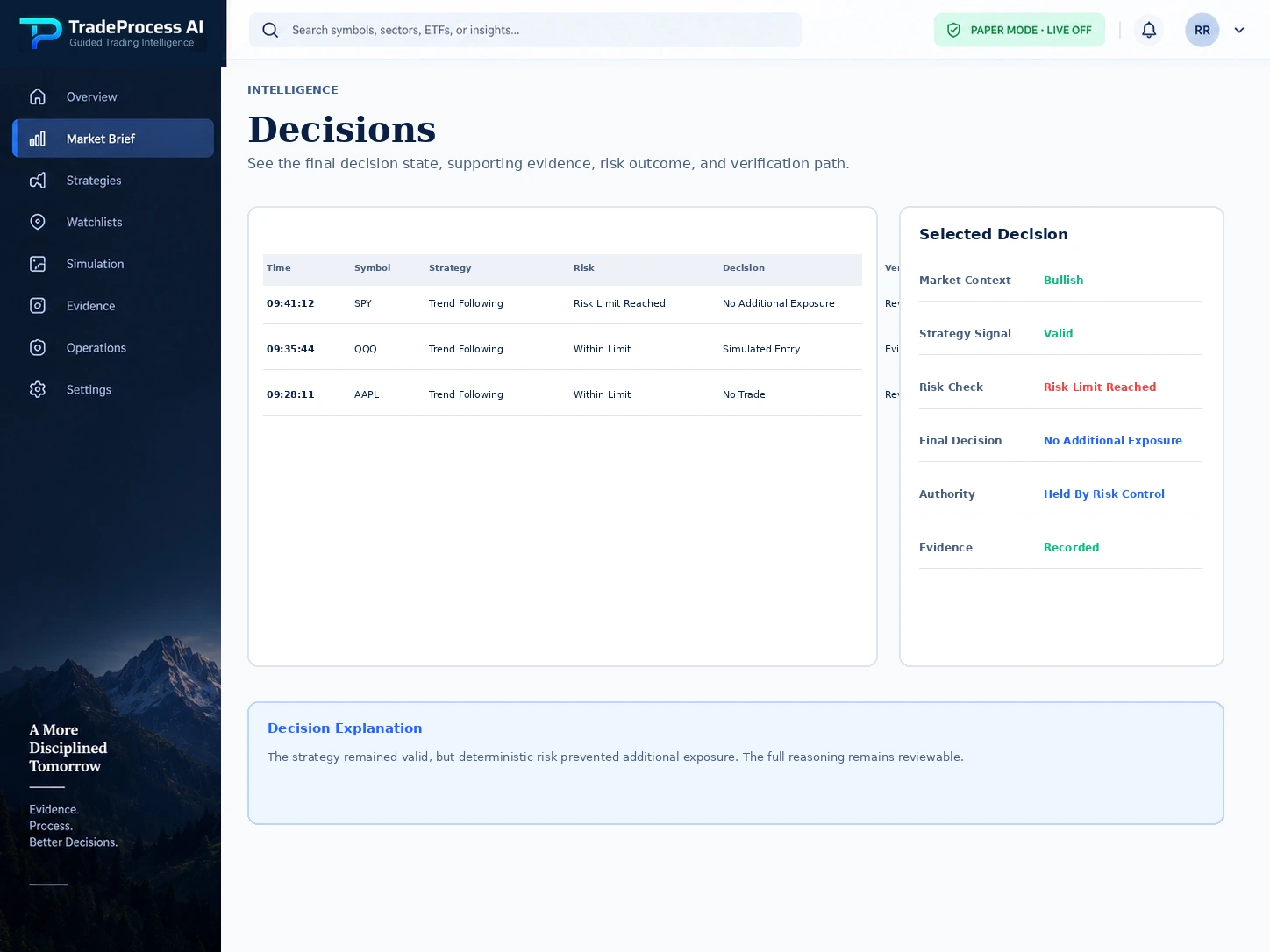
TradeProcess AI illustrative decision records screen.
PAPER MODE · LIVE OFF
PRODUCT VIEWDecision Records

SUBFEATURE 07

Decision Records

Save the evidence and safety state behind a decision so later review does not depend on memory. The record helps separate what was known at the time from what only became obvious afterward.

WHAT IT DOES

Persist the reasoning and state surrounding a decision so later review does not depend on memory.

WHAT YOU SEE
  • Decision identity and timing
  • Supporting evidence and safety state
  • Recorded explanation of why the decision existed
WHY IT MATTERS

A durable record supports learning from process quality instead of rewriting the original thesis after a win or loss.

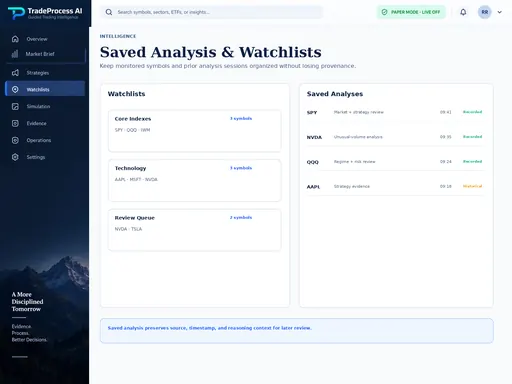
TradeProcess AI illustrative saved analysis and watchlists screen.
PAPER MODE · LIVE OFF
PRODUCT VIEWSaved Analysis & Watchlists

SUBFEATURE 08

Saved Analysis & Watchlists

Keep monitored symbols and prior analysis organized so useful research can be reopened without turning a watchlist into an implied recommendation list.

WHAT IT DOES

Organize monitored instruments and prior research sessions without turning a watchlist into an implied recommendation list.

WHAT YOU SEE
  • Saved instruments or analysis sessions
  • Prior context and provenance
  • Research that can be reopened and compared later
WHY IT MATTERS

Reusable analysis reduces repeated reconstruction while preserving the difference between something worth watching and something approved for action.

PRACTICAL USE CASES

Challenge The Idea Before It Reaches Risk

The best time to find weak evidence, poor regime fit, or an attractive but fragile backtest is before the candidate reaches the risk check.

SCENARIO 01

Compare two plausible strategies in the same regime

Instead of choosing the strategy with the most attractive headline result, compare configured rules, evidence quality, estimated costs, regime fit, and the context in which each result was produced.

SCENARIO 02

Challenge a high-confidence idea when the regime changed

A strategy may have supportive historical evidence while current volatility, liquidity, or event context no longer resembles the environment where that evidence was strongest. The workspace makes that mismatch visible before risk review.

HOW IT CONNECTS

Research Becomes Useful When The Rest Of The Process Can Use It

Decision Intelligence builds the case. Risk decides what the account can carry, PAPER Trading simulates the allowed action, and Evidence preserves what was known at the time.

Deterministic Risk

Consumes the candidate only after intelligence has organized the evidence; risk remains a separate authority and can still reduce or block exposure.

PAPER Trading

Receives a reviewed candidate and preserves its context when the workflow advances into simulation.

Evidence & Review

Stores the reasoning, provenance, and later outcome so expected-value or regime conclusions can be revisited rather than remembered selectively.

LIMITATIONS & BOUNDARIES

Better Evidence Still Does Not Remove Uncertainty

Historical results, regime labels, expected value, and AI explanations can improve the review. None can guarantee the next market outcome.

  • Decision Intelligence does not predict the market or guarantee that a strategy with positive historical expectancy will remain profitable.
  • Regime classification and expected-value estimates are evidence inputs, not execution or risk authority.
  • Stale, low-quality, or poorly calibrated evidence should reduce trust rather than being hidden behind a confidence score.
  • AI is used for organization and explanation; deterministic strategy and risk logic remain separate from AI narration.

SAFETY BOUNDARY

AI Can Explain The Evidence. It Cannot Change The Rules.

AI execution authority
None
AI risk authority
None
Deterministic risk controls
Authoritative
Customer live broker execution
Off
Manual reduce / close during halt
Preserved

CAPABILITY QUESTIONS

Questions About Expected Value, Regime Fit, And AI

These questions cover expected value, regime context, strategy evidence, and the role AI is allowed to play in the research process.

Is expected value a forecast?

No. It is an evidence assessment based on supplied win/loss characteristics, estimated costs, regime fit, evidence quality, calibration quality, and freshness. It does not guarantee the next outcome.

What does market regime add to a strategy decision?

It provides context about the environment in which the strategy is being considered. A strategy can have strong historical evidence and still be a weak fit for the present regime.

Can AI promote a strategy because it sounds convincing?

No. AI can summarize and explain the evidence, but it does not become strategy approval, risk authority, or execution authority.

Does this capability change the PAPER / live-off boundary?

No. Customer execution remains PAPER / simulation and live broker execution is off. AI remains advisory and deterministic server-owned safety controls remain authoritative.

GUIDED TRADING INTELLIGENCE

Build The Case Before You Build The Position

Use the research workspace to make the reasoning clear enough to test and challenge before it reaches the risk check.

Create your workspaceExplore other features
PAPER MODE · LIVE OFF · Customer live broker execution is off.