OPERATIONS

Know Whether The System Is Healthy Before You Trust The Output

See whether scheduled jobs ran, providers responded, system records agree, and the latest information is current before you trust what the platform shows.

PAPER MODE · LIVE OFFREAL CAPITAL OFFAI execution authority · NoneAI risk authority · None
TradeProcess AI illustrative operations workspace.
Simulated product view · Operations Workspace

WHY THIS MATTERS

Healthy services make the evidence more trustworthy. They do not grant live authority or override risk.

THE PROBLEM

A Green Screen Can Still Hide Out-Of-Date Or Incomplete Information.

A dashboard can look normal while data is stale, a scheduler missed a cycle, reconciliation is incomplete, or a provider is degraded. Without operational context, “nothing looks wrong” can become false confidence.

WHAT CHANGES

Make System Health Something You Can Verify.

Make runtime health visible enough to tell the difference between a healthy PAPER workflow and one that is stale, degraded, or not yet verified.

THE GOAL

Make the runtime that produces trading evidence observable enough to distinguish healthy scheduled PAPER operation from stale data, missed cycles, reconciliation problems, or provider degradation.

THE INPUTS

Trust Starts With Current, Consistent System Information.

Before you rely on a result, check whether scheduled jobs ran on time, providers responded, system records agree, and the services behind the workflow are healthy.

INPUT / EVIDENCE

Scheduler state

Scheduled cycle timing and runtime activity show whether expected PAPER work is actually occurring.

INPUT / EVIDENCE

Reconciliation evidence

Execution and position state must agree with recorded PAPER activity before downstream evidence is treated as clean.

INPUT / EVIDENCE

Provider/runtime health

Data-provider availability, runtime events, and service-health signals help explain degraded or missing evidence.

INPUT / EVIDENCE

Authority state

Operational status is shown alongside PAPER/live-off and deterministic-control state so “healthy” cannot be mistaken for “authorized to trade live.”

WHAT YOU GAIN

Know Whether The Output Deserves Your Trust

Make runtime health visible enough to tell the difference between a healthy PAPER workflow and one that is stale, degraded, or not yet verified.

  • See scheduler and runtime context without opening infrastructure consoles.
  • Review reconciliation and provider health when downstream evidence depends on them.
  • Keep operational warnings separate from trading authority and risk decisions.
  • Use runtime evidence to diagnose problems without pretending the system is ready when it is not.

HOW IT WORKS

Find The Problem, Identify The Cause, Then Verify The System.

Check what failed, identify where it failed, confirm the records are current and consistent, then decide whether the PAPER results are reliable enough to use.

  1. 01
    Observe the scheduled cycle

    Confirm the expected runtime is executing rather than assuming silence means success.

  2. 02
    Check source and freshness

    Determine whether market/provider inputs are available and fresh enough for downstream evidence.

  3. 03
    Reconcile recorded state

    Compare expected PAPER activity with persisted order, position, and runtime state and surface errors rather than smoothing them over.

  4. 04
    Escalate degraded state

    Treat stale, failed, or unreconciled operation as evidence requiring investigation—not as permission to fabricate a completed cycle or readiness result.

FEATURES IN DEPTH

Health Signals Need Context, Not Just Green Dots

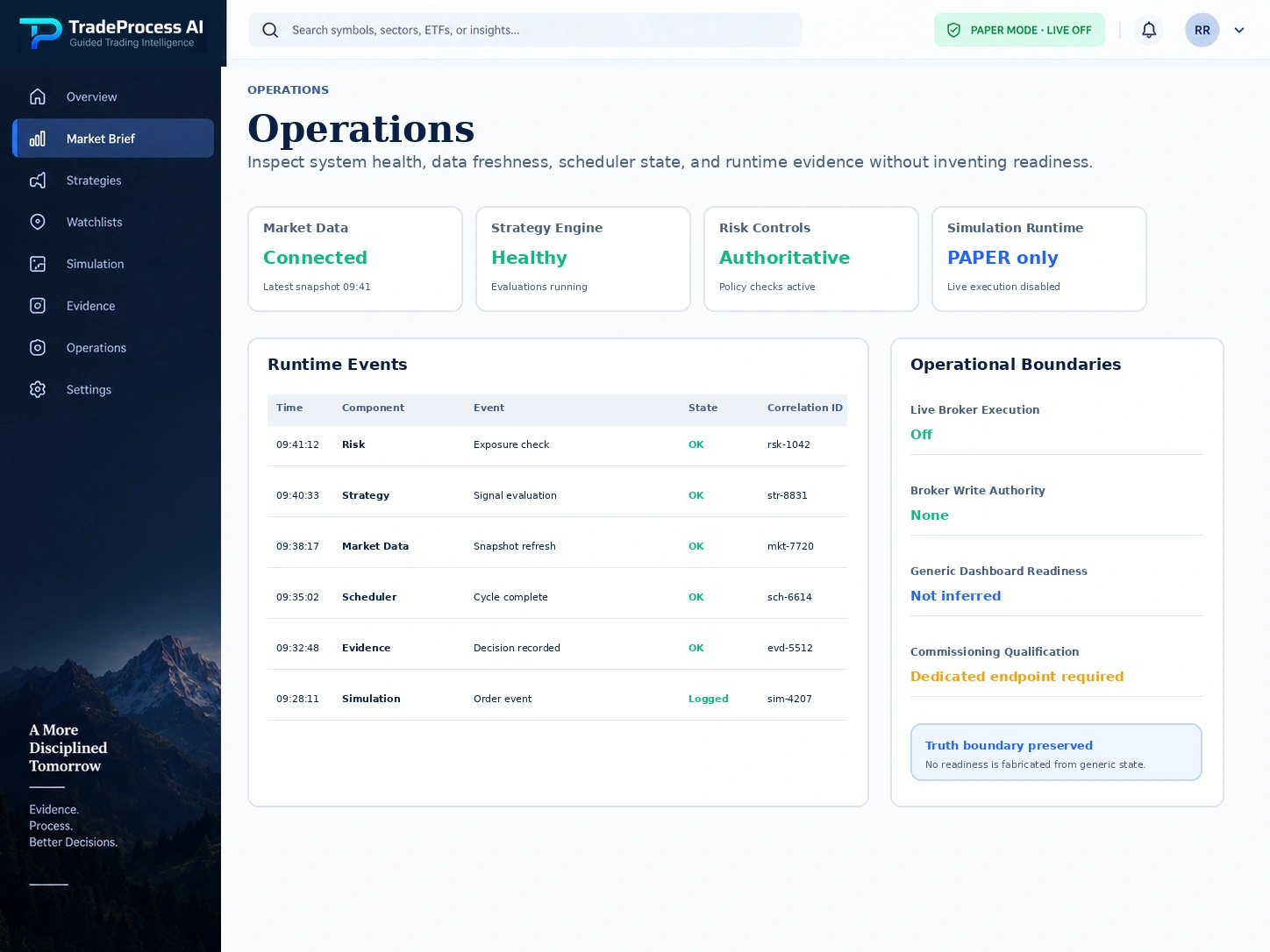
Operations views should show what ran, whether the records agree, which providers responded, and whether the information is current enough to trust the rest of the workflow.

TradeProcess AI illustrative operations workspace.
PAPER MODE · LIVE OFF
PRODUCT VIEWOperations Workspace

SUBFEATURE 01

Operations Workspace

Review scheduler, reconciliation, provider, and runtime information in one dedicated workspace while the customer environment remains PAPER-only.

WHAT IT DOES

Concentrate scheduler, reconciliation, provider, runtime, and service-health evidence into a dedicated verification surface.

WHAT YOU SEE
  • Runtime/scheduler context
  • Reconciliation and provider state
  • Operational warnings and evidence quality cues
WHY IT MATTERS

Users and operators can investigate the machinery behind the evidence without turning infrastructure details into the primary trading interface.
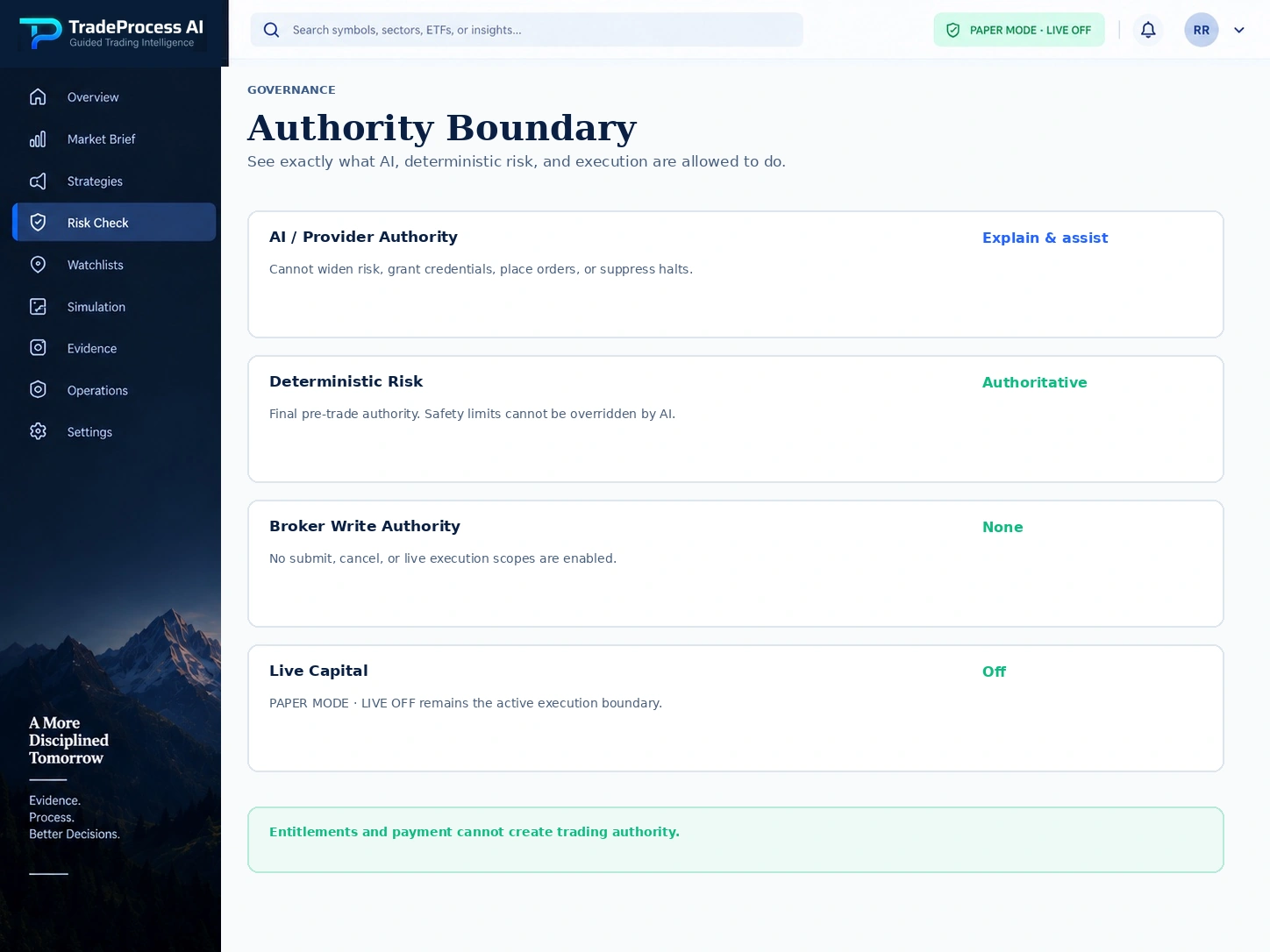
TradeProcess AI illustrative authority boundary.
PAPER MODE · LIVE OFF
PRODUCT VIEWAuthority Boundary

SUBFEATURE 02

Authority Boundary

Keep AI authority, deterministic controls, and customer execution state visible beside system health. A healthy service can support confidence in the evidence, but it cannot authorize a trade.

WHAT IT DOES

Keep operational health visually separate from AI authority, risk authority, and live-execution permission.

WHAT YOU SEE
  • PAPER/live-off state
  • AI authority limits
  • Deterministic-control authority alongside runtime health
WHY IT MATTERS

A healthy service is necessary for reliable evidence, but it must never be presented as permission to risk capital.

PRACTICAL USE CASES

When A Quiet Screen Gives A False Sense Of Health

Operational visibility matters when a scheduler misses a cycle, a provider degrades, or reconciliation is incomplete even though the customer interface still loads.

SCENARIO 01

A scheduled PAPER cycle appears to be missing

Operations evidence can distinguish a scheduler miss from a provider problem, a no-op cycle, or a downstream persistence issue before anyone fills the gap manually.

SCENARIO 02

A provider is degraded while strategy evidence still exists

The system can surface the provider/runtime problem and restrict trust in new evidence instead of letting old or partial data silently stand in for a healthy feed.

DEEPER PLATFORM COVERAGE

Inspect The System Behind What You See.

See scheduled jobs, provider responses, record consistency, system events, and service health behind the results shown across the platform.

  • Scheduler
  • Reconciliation
  • Providers
  • Provider Administration
  • Runtime Events
  • Service Health
Operational status is informational. It does not grant live trading authority or override deterministic controls.

HOW IT CONNECTS

Operations Keeps The Rest Of The Platform Honest

Research, PAPER activity, and readiness evidence are only as trustworthy as the system information behind them. Operations shows whether that information is current and reliable.

Evidence & Review

Operational health determines whether newly produced evidence has the runtime quality needed for reliable review and commissioning.

PAPER Trading

Order/position reconciliation and runtime state help distinguish intended simulation from what the simulator actually recorded.

Governance

Incident, audit, and authority semantics make sure operational recovery does not weaken safety controls just to restore a green status.

LIMITATIONS & BOUNDARIES

Healthy Infrastructure Does Not Mean Trading Is Authorized

A healthy scheduler or provider can support confidence in the data path, but it cannot approve a strategy, widen risk, or grant live execution.

  • A green operations screen is not trading authority and is not proof that a strategy is profitable.
  • Operational status can be unavailable or degraded; the interface should show that state rather than inventing confidence.
  • Recovery should not fabricate PAPER sessions, outcomes, or readiness evidence to hide a missed runtime cycle.
  • Provider health and reconciliation are evidence-quality inputs, not substitutes for deterministic risk or authorization.

SAFETY BOUNDARY

A Healthy Runtime Does Not Grant Trading Authority

AI execution authority
None
AI risk authority
None
Deterministic risk controls
Authoritative
Customer live broker execution
Off
Manual reduce / close during halt
Preserved

CAPABILITY QUESTIONS

Questions About System Health, Record Consistency, And Providers.

These answers explain what operational status means, what it does not mean, and how system problems should change how much you trust the results shown elsewhere.

Does a healthy runtime mean the platform is ready for live trading?

No. Runtime health supports confidence in the evidence being collected. Live-capital authority remains a separate approval boundary.

What should happen when a scheduled cycle is missed?

The missing cycle should remain visible and be investigated. The platform should not synthesize a session simply to keep readiness counters moving.

Why is reconciliation part of operations?

Because evidence is only useful when recorded orders, positions, and runtime state agree closely enough to reconstruct what actually happened.

Does this capability change the PAPER / live-off boundary?

No. Customer execution remains PAPER / simulation and live broker execution is off. AI remains advisory and deterministic server-owned safety controls remain authoritative.

GUIDED TRADING INTELLIGENCE

Verify The System Before You Rely On The Result

Use operational evidence to distinguish a healthy PAPER workflow from one that is stale, degraded, or still waiting for reconciliation.

Create your workspaceExplore other features
PAPER MODE · LIVE OFF · Customer live broker execution is off.