Memory Changes After A Win Or Loss
A win or loss changes the way people remember a trade. Without a durable record, the original setup, missing evidence, and risk state can slowly turn into a cleaner story than the one that actually existed.
EVIDENCE & REVIEW
Preserve what the system knew, which safety state applied, what PAPER action followed, and how the outcome matured—before hindsight has a chance to rewrite the story.

WHY THIS MATTERS
A win or loss changes the way people remember a trade. Without a durable record, the original setup, missing evidence, and risk state can slowly turn into a cleaner story than the one that actually existed.
Go back to what the system knew at the time, which rule or risk state applied, what PAPER outcome followed, and what evidence supports any readiness conclusion.
Preserve what the platform knew, which rules applied, what PAPER action followed, and how outcomes matured so decisions can be reviewed from persisted evidence instead of hindsight or memory.
THE INPUTS
Decision records become useful when timing, source, strategy state, risk state, simulated activity, and outcome evidence remain distinguishable and traceable.
The candidate, strategy context, risk decision, authority state, and timing provide the original frame for later review.
Source, timestamp, and freshness context help distinguish verified inputs from stale, missing, inferred, or later-added information.
Maturing outcomes at defined horizons can be compared with the original decision without turning one result into proof of strategy quality.
Commissioning criteria such as genuine session counts, evidence span, outcome completeness, stale-state rate, reconciliation quality, and fresh operational snapshots support operational-readiness assessment.
WHAT YOU GAIN
Go back to what the system knew at the time, which rule or risk state applied, what PAPER outcome followed, and what evidence supports any readiness conclusion.
HOW IT WORKS
Preserve the decision, attach the evidence, mature the PAPER outcome on schedule, then review the process without changing what was known at the time.
Persist the evidence and safety context that existed when the decision was made.
Record genuine PAPER outcomes at their defined horizons rather than filling missing evidence with synthetic or manually backfilled results.
Review whether the strategy logic, risk decision, and runtime behaved as intended independently of whether the individual simulated trade made or lost money.
Use documented operational evidence to determine whether commissioning criteria are met, while keeping readiness distinct from permission to activate live capital.
FEATURES IN DEPTH
Evidence Review, Decision Explanation, and Data Provenance help you answer three questions: what happened, why it happened, and where the supporting evidence came from.
SUBFEATURE 01
Review the evidence attached to a decision before treating the outcome as validation. Supporting context and missing evidence stay visible so confidence does not replace proof.
Bring the original decision evidence, safety state, and later outcomes into one review surface.
The user can evaluate the quality of the process instead of judging the decision only by its final P&L.
SUBFEATURE 02
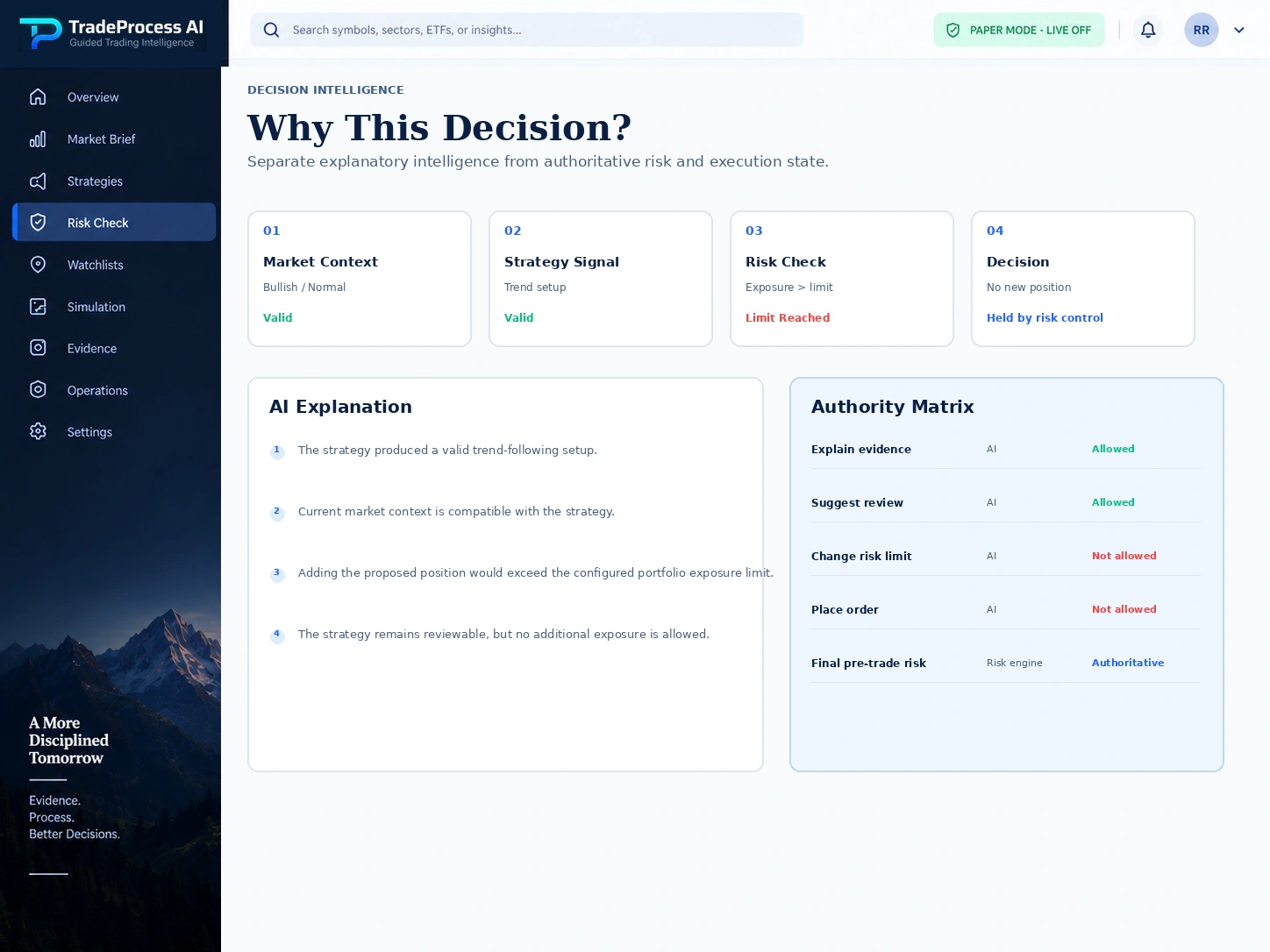
See why a decision exists while AI remains advisory and safety state stays server-owned. The explanation helps you read the evidence; it does not create execution or risk authority.
Translate the persisted evidence into understandable reasoning without giving the explanation authority to change the underlying decision.
Explanation improves auditability, but it remains subordinate to the recorded evidence and server-owned control state.
SUBFEATURE 03
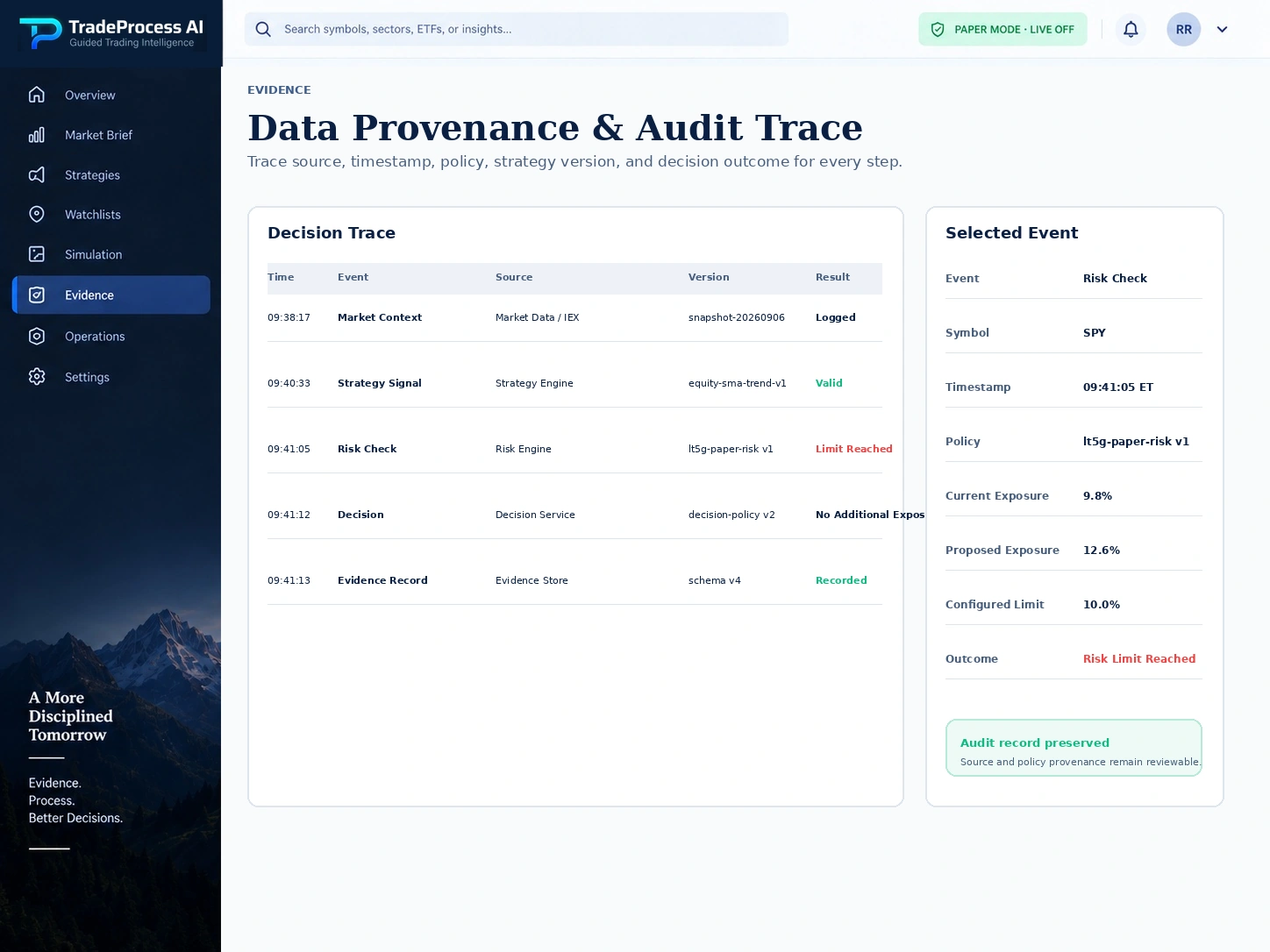
Keep source, timestamp, and context visible so you can tell whether evidence is current, stale, missing, or coming from a different source.
Expose where evidence came from, when it was observed, and whether it was fresh enough for the decision being reviewed.
Provenance makes it harder to confuse stale or later-added information with what the system actually knew at decision time.
PRACTICAL USE CASES
The evidence trail matters most when an outcome tempts you to rewrite the original thesis or treat incomplete readiness evidence as proof.
The persisted decision record shows what evidence and safety state existed before the outcome. That makes it possible to ask whether the process was sound even when the result was unfavorable.
Genuine scheduled sessions, outcome maturation, stale/reconciliation rates, and evidence span can be tracked per instrument. Missing evidence remains missing until the runtime actually produces it.
DEEPER PLATFORM COVERAGE
Longer-term review keeps simulated outcomes, readiness checks, and the evidence behind them available after the original decision is over.
HOW IT CONNECTS
Research builds the case, risk constrains it, PAPER Trading records the simulated action, Operations verifies the runtime, and Evidence keeps the story reviewable.
Contributes research, strategy evidence, regime context, and explanations that should remain traceable after the decision.
Contributes the authoritative reason exposure was allowed, reduced, or blocked.
Provides runtime and reconciliation evidence needed to judge whether a PAPER outcome or readiness conclusion can be trusted.
LIMITATIONS & BOUNDARIES
Good evidence reduces ambiguity about what happened. It does not turn historical or simulated outcomes into a forecast of future performance.
CAPABILITY QUESTIONS
These answers cover what gets recorded, how PAPER results are tracked over time, and why readiness evidence does not grant live-trading permission.
Readiness is an evidence-backed assessment that defined commissioning conditions have been met. Live-capital authority is a separate governance decision and is not granted automatically by a READY result.
A 15-minute result cannot substitute for a later 1-hour or 4-hour horizon. Each horizon answers a different question, so the platform should preserve incomplete state until the genuine outcome exists.
Commissioning evidence should come from genuine scheduled PAPER operation. Synthetic or manual backfills would weaken the meaning of the readiness record.
No. Customer execution remains PAPER / simulation and live broker execution is off. AI remains advisory and deterministic server-owned safety controls remain authoritative.
GUIDED TRADING INTELLIGENCE
Use the evidence trail to separate a good process from a lucky result—and a bad process from an unlucky one.
PAPER MODE · LIVE OFF · Customer live broker execution is off.